Register a Deal with a Partner
Register a deal when a customer needs to buy through a partner instead of directly from you — for example, when a prospect requires purchasing through a specific reseller.
Overview
Registering a deal creates a Co-Sell record that both you and the partner can track, including customer details, collaboration requests, the partner’s attribution, and revenue share terms.
Step 1: Start a Deal Registration
-
Go to Fours Console, then Partners.
-
In All Partners, click the name of the partner you want to register the deal with.
-
Click Register a Deal in the top right corner of the partner’s profile.
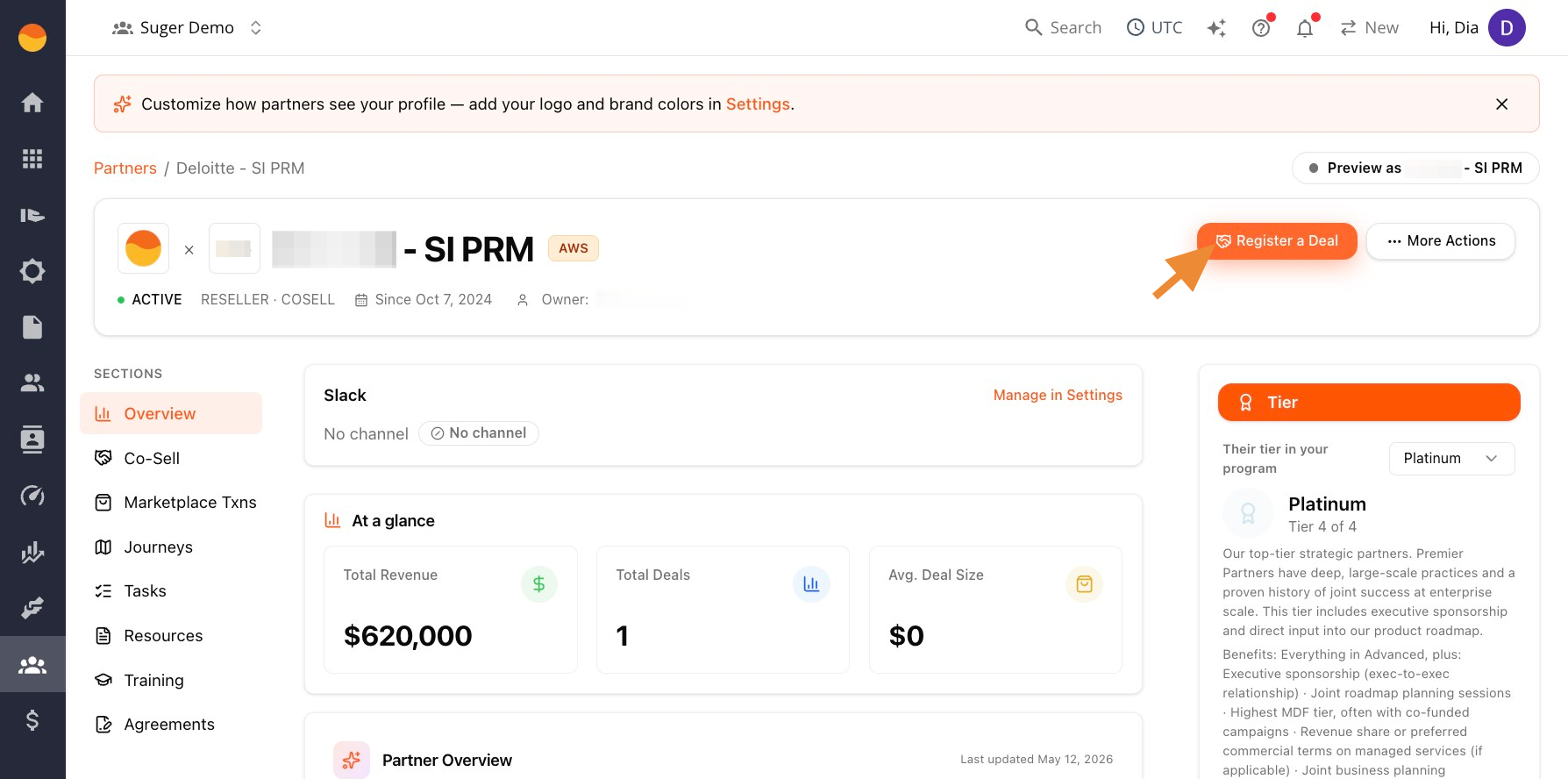
A deal needs a Relationship Type, which says whose product is being sold. If neither the partnership nor your organization has one yet, Register a Deal stops at Set your org’s Relationship Type first, with Go to Settings; if your organization has one but this partnership doesn’t, it stops at Set the relationship type first. See Set your Relationship Type.
Step 2: Choose or Skip a CRM Opportunity
The Select an Opportunity window lets you link the deal to an existing CRM opportunity before completing the registration form.
-
Choose Salesforce or HubSpot, depending on where the opportunity lives.
-
Search by opportunity name, ID, or account, or browse the list. Each result shows the current opportunity stage and deal value, when available.
-
Select an opportunity, then click Continue.
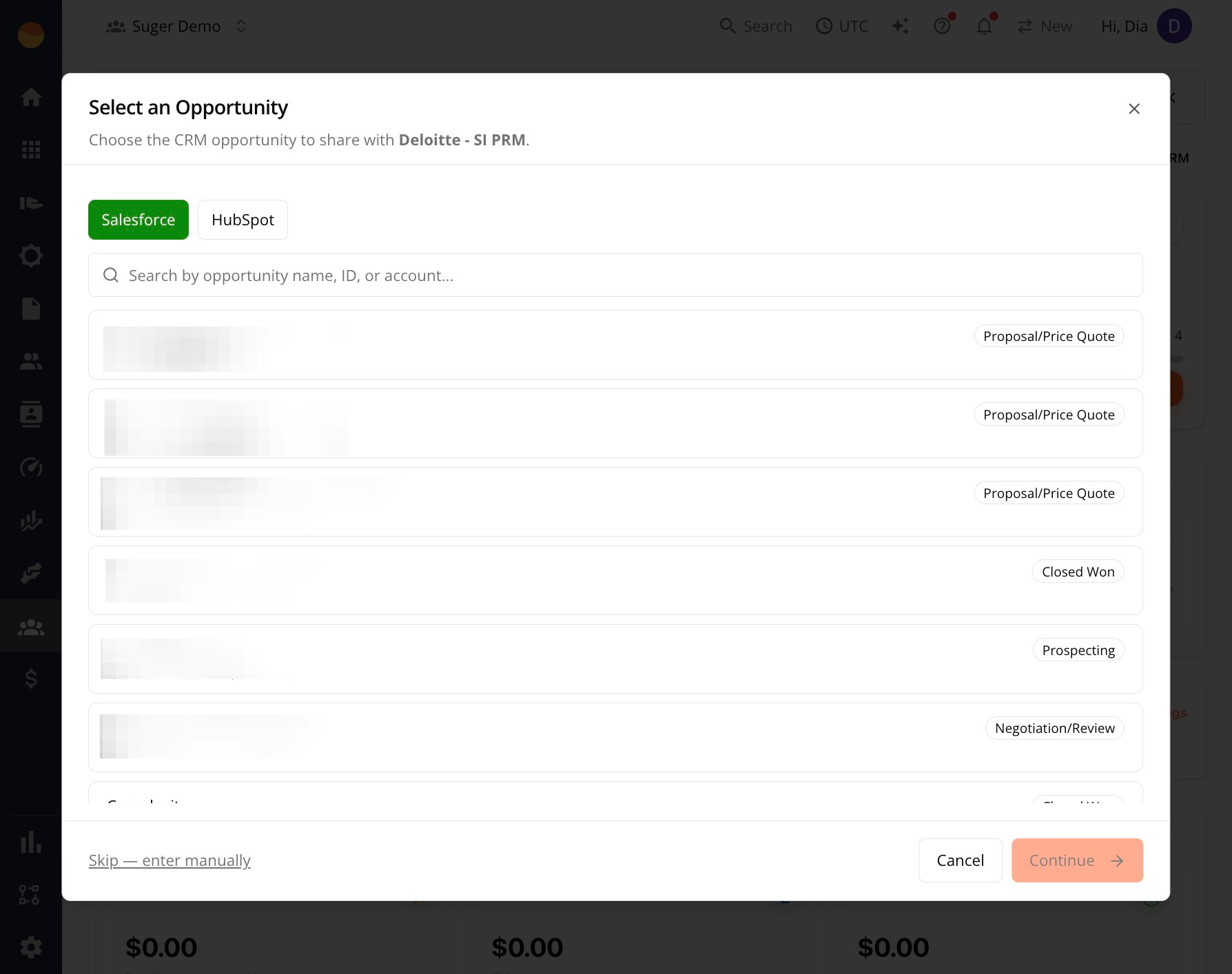
When you select a CRM opportunity, Fours pre-fills parts of the registration form using information from that record, so you don’t have to enter the same details twice.
Skip and Enter Details Manually
If the deal isn’t in your CRM, or you don’t use Salesforce or HubSpot, click Skip - Enter Manually. This opens the registration form with blank fields you’ll need to complete.

When Both Products Can Be Sold
When the partnership’s Relationship Type is Both products can be sold, Fours next asks Whose product is being sold in this deal? and records your answer on the co-sell, so both sides know how it was registered. Pick Our product (“We sell it. {partner} brought the deal.”) to register as the Seller, as the rest of this page describes, or {partner}‘s product (“{partner} sells it. We brought the deal.”) to register as the Referrer, in a form titled Share Co-Sell · {partner}‘s product. A registration on the partner’s behalf doesn’t ask: it registers you as the Seller.
Step 3: Complete the Share Co-Sell Form
The form is split into five tabs: Opportunity & Customer, Deal Details, Attribution, Partner Collaboration, and Contacts.
The number on each tab shows how many required fields still need to be completed. When a tab is complete, the number changes to a checkmark. You can move between tabs at any time using Back and Next.
Which fields the form shows, and which of them are required, follow your organization’s deal registration form. See Choose the Fields of Your Deal Registration Form.
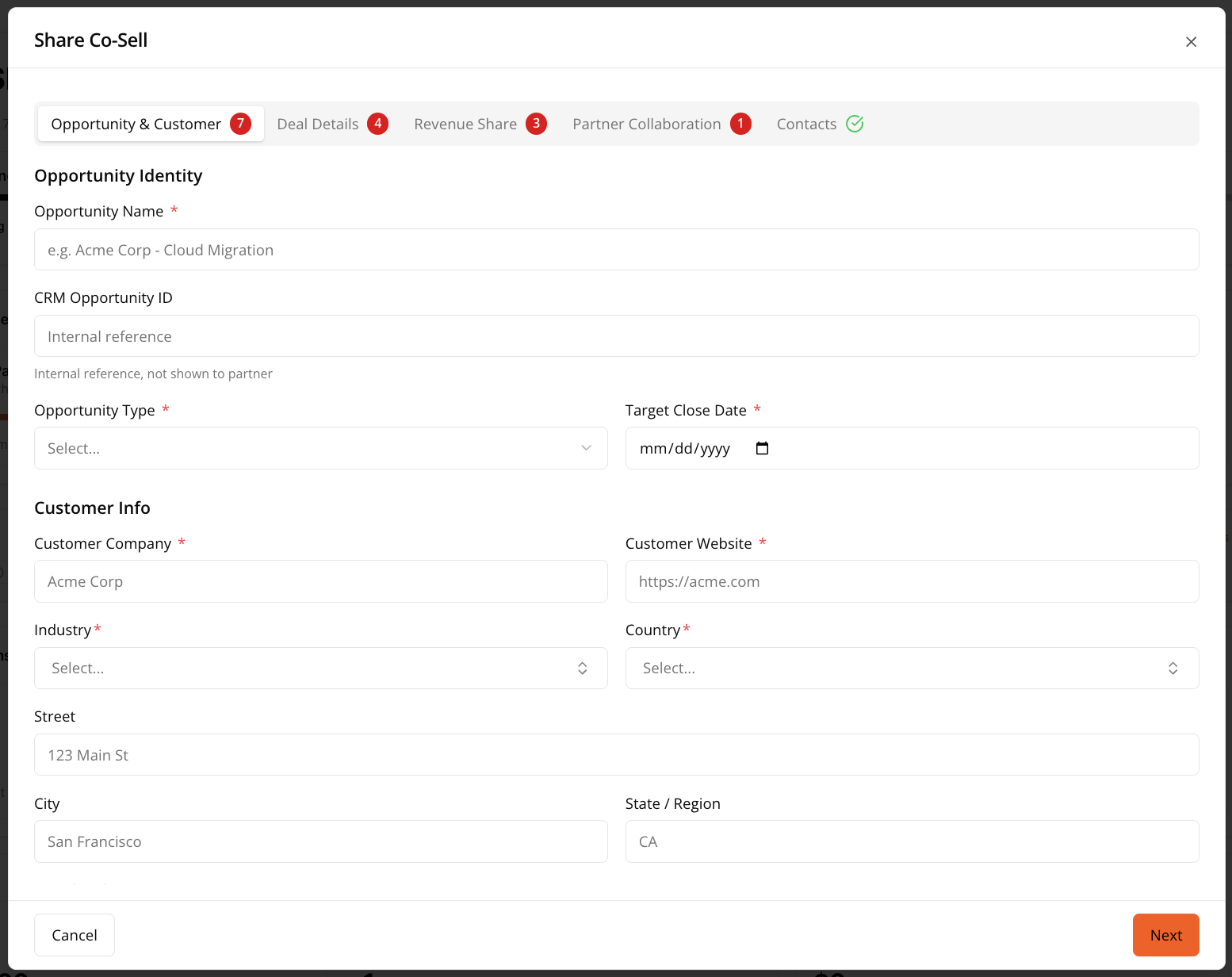
Opportunity & Customer
- Enter an Opportunity Name. This identifies the deal internally and to your partner.
- Add a CRM Opportunity ID if you have one. This is an internal reference only; the partner never sees it.
- Confirm the Opportunity Type and Target Close Date, especially if this data came from a linked CRM record.
- Confirm or enter the Customer Company, Customer Website, Industry, and Country. This is the customer information your partner sees when deciding whether to accept.
- Optionally, add the customer’s Street, City, State/Region, and Postal Code if you want a fuller address on record.
- Optionally, add the Customer Contact: the Full Name, Email, and Role of the person at the customer the deal is about. Your partner sees the contact on the deal. You can set it only when you register the deal; it can’t be changed afterward, so it shows locked when you edit the deal.
Customer Website is validated for shape, not just for being filled in. It needs at least two labels separated by a dot and an alphabetic top-level domain:
| Entry | Accepted? |
|---|---|
acme.com | Yes |
www.acme.co.uk | Yes |
https://acme.com/about?x=1 | Yes — the scheme and path are stripped |
n/a | No |
192.0.2.10 | No — an IP address is not a website |
pat@acme.com | No — that’s an email address in the wrong field |
A rejected entry shows “Enter a valid website, e.g. acme.com”. Fours checks the format only — it never resolves the domain — so a well-formed typo still passes.
A filled-in Customer Contact email must be an email address. Once the deal is shared, the contact appears in a Customer contact section on the deal’s customer details, for you and your partner, with the email as a link; a deal without one doesn’t show the section. Fours doesn’t send notifications to the customer contact, and the contact isn’t sent to AWS, Azure, or GCP.
Deal Details
- Write a Partner Brief (minimum 20 characters) describing the customer’s core need and why this partner is the right fit. This is the main pitch your partner reads before accepting, so make it specific.
- Optionally, add a Use Case — a short label for the customer’s primary use case (for example, “Workload migration and expansion”).
- Confirm the Deal Value and Currency.
- Optionally, enter the Total Account ARR: the customer account’s total ARR. It’s internal only and never shown to partners. When you started from a CRM opportunity and your co-sell field mapping maps it, it’s filled in for you.
- Check off the Transaction Model: Cloud Marketplace, Reseller Agreement, Direct Partner Contract, or Other. You can select more than one.
Attribution
This tab records why the partner is on the deal and what they’re paid.
- Pick the partner’s Attribution Role: Sourced, Influenced, or Transacted. It starts at Sourced. The deal page shows the role as Partner sourced, Partner influenced, or Transacted. If your deal registration form hides Partner Attribution Role, or asks it of Referrers only, the picker isn’t shown and the deal records Sourced.
- Set Show deal value to partner. It’s on by default, which lets partners see both the deal amount and their commission; the line under the switch says what the partner will see. Leaving it on is typically recommended for resellers and co-sell partners.
Pre-filled from your CRM. When you started from a CRM opportunity and your Fours co-sell field mapping maps a CRM field to Attribution Role or to Commission Type, the form takes that value from the opportunity instead of its default, unless you’ve already picked the field yourself. A mapped value that isn’t one of the three roles is ignored, and the role stays at Sourced. The mapping fills the first partner on the deal only; a partner you add in the form keeps its own picker. Everything else on this tab comes from Fours and the partner’s commission plan, and nothing here is synced back from the CRM after you submit.
When commissions are turned off for your organization (Partners → Settings → Features), the tab holds only these two settings. Otherwise, continue with the commission terms:
-
Choose a Commission Type first. This selection determines the commission settings available for the deal. Available options include:
- Referral Fee
- Reseller Margin
- Co-Sell Revenue Split
- Finder’s Fee
After you select a commission type, the Commission Rules panel appears. It shows the Rate, Maximum Cap, and Minimum Deal Value that apply to the partner, headed with where they came from (for example From Default settings). When those terms are a discount off list price, the panel shows only that discount instead. These values come from the partner’s Custom Plan if one exists, otherwise from your organization’s Standard Defaults. To learn more, see Set Up and Manage Commission Plans.
-
Confirm the Revenue Share Model and Payment Trigger. If a plan resolved automatically, these should already reflect it, but you can adjust them for this specific deal if it needs different terms than the plan default.
On Reseller Margin, the model can also be Discount off list price: enter a Discount (%), and there is no payment trigger or commission to track, because the reseller buys at that discount rather than being paid. See Reseller Discount off List Price.
-
Optionally, set a Clawback Window in days (not offered on a discount). If the deal churns within this window after payment, the commission can be reversed. Leave it blank if you don’t need a clawback.
-
Add any Revenue Share Notes for context.
Partner Collaboration
- Check off What I Need From This Partner. At least one is required.
- Optionally, add Next Steps (for example, “Schedule joint discovery call”) and any Notes for Partner.
Contacts
The Contacts tab has a card for each side of the deal. The first person on each card is set outside the form: they carry a lock badge, and hovering it reads “Set in Partner Details; can’t be changed here”.
- Your team · {your organization} — Who on your team owns this co-sell. It starts with the partner’s Partner Manager, the teammate assigned to the partner in Partner Details, followed by you. When you started from a CRM opportunity and your co-sell field mapping maps Owner Team people with a role (Opportunity Owner, Account Owner, CSM, or Account Manager), they follow, titled with their role; the default Salesforce and HubSpot mappings map the opportunity or deal owner as Opportunity Owner. Each person appears once: someone already on the card takes the role on their own row, a person named for several roles keeps the first, and a mapped person without an email is left out. The Partner Manager is never replaced. Click Add contact to add a teammate: pick them under Choose team member, or type their Name, Email, and Title under Enter manually. Remove takes a teammate off again, you included.
- Their team · {partner} — Who at {partner} receives this co-sell. It starts with the partner’s champion, set in the partner’s contacts. The co-sell is sent to the champion, who owns it on the partner’s side, and to everyone else on this card; Your team gets its own copy. Each side’s email also reaches the people its organization has set to receive co-sell emails in its email notification settings, and no one else — see Who Receives Co-Sell Emails. Add contact adds someone else at the partner, picked from the partner’s contacts or typed in; a typed address must be a company address, and not on your own organization’s domain.
Submit won’t go through until both cards have their first person. Without a Partner Manager, the Your team card reads “{partner} has no Partner Manager. Assign one in Partner Details before sharing.” A partner with no champion doesn’t stop you: the Their team card reads “{partner} has no partner champion. Enter who at {partner} should receive this co-sell: they get the notification and the one-click Accept. Everyone here joins both sides’ contacts once it is accepted.”, and the first person you type or pick there receives the co-sell. A registration on the partner’s behalf is the exception: it still needs the champion, and without one the card reads “{partner} has no partner champion. Set one in {partner}‘s Contacts before sharing.” The two cards look the same whichever product is being sold. A deal with more than one partner has a Their team card for each, with the partner’s role after its name. The Contacts tab’s number counts what these checks still find missing — the Your team card while it has no Partner Manager or a teammate without a name and email, and each partner whose Their team card isn’t complete — so the tab shows its checkmark only once its contacts no longer hold Submit back.
Sharing doesn’t add anyone to either side’s contacts. Once the partner accepts the co-sell, everyone on it joins both sides’ contacts; see Contacts. When you register a deal on a partner’s behalf, the Their team card reads “Who at {partner} is notified of this registration.”: the champion is the person Fours emails about it.
Step 4: Submit and Track Your Deal Registration
Once every tab shows a checkmark, click Submit. It is at the bottom of every tab, so you don’t have to page through to the last one.
After you submit, the deal appears on the partner’s profile under the Co-Sell tab, with a status of Pending Acceptance until the partner responds.
A deal you register with Register a Deal on Partner’s Behalf doesn’t wait for the partner: it’s active on both sides as soon as you submit, and Fours emails the partner to let them know. See Work a Partner Record.
Choose the Fields of Your Deal Registration Form
Your deal registration form decides which of the standard fields above a registration asks for, which of them are required, and who is asked. It applies to new deals registered with you in the Fours Console, including on a partner’s behalf, from your partners’ portals, in bulk uploads, and through the API. It applies to your public deal registration link too: that page shows, hides, and requires Customer Website, Industry, Country, Street, City, State / Region, Postal Code, Partner Brief, Use Case, Transaction Model, the deal value’s Currency, Partner Attribution Role, What I Need From This Partner, and Notes for Partner the way you set them for Referrers. It never asks CRM Opportunity ID or any other Revenue Share field, so a requirement on those doesn’t apply there, and a public registration is never refused for a field it can’t fill in. Next Steps appears there too, and what a submitter types in it is carried into the registration you receive. Deals that already exist keep the values they were submitted with, and editing a deal later doesn’t apply your settings.
- Go to Fours Console, then Partners.
- Click Settings at the bottom of the rail, then Co-Sell.
- Expand the Deal registration form section.
- In the Standard fields table, set each field you want to change. The fields are grouped under the tab of the form they appear on.
- Click Save at the bottom of the section. It saves only this section’s settings.
| Column | What it sets |
|---|---|
| Required | Required or Optional — or Default, which keeps the standard rule and names it, as in Default (required) or Default (optional). |
| Shown | A switch. Turn it off to hide the field; a hidden field is never required, and its other two settings are locked until you turn it back on. Turning it on again resets Required to Default. |
| Asked of | All partners, Sellers only, or Referrers only. Sellers only asks the field when the deal is registered as the Seller, as you do on this page; Referrers only asks it when a partner registers the deal with you as the Referrer. Whoever isn’t asked doesn’t see the field and doesn’t have to fill it in. The info icon on the column’s header says the same: “Only sets who sees the field. Required applies to everyone it is shown to.” |
Some fields can’t be changed, because a registration can’t exist without them or commissions are calculated from them. The table lists them in one Always asked line at the top of each tab’s group:
| Tab | Fields you can change | Always asked |
|---|---|---|
| Opportunity & Customer | CRM Opportunity ID, Customer Website, Industry, Country, Street, City, State / Region, Postal Code, Customer Contact Name, Customer Contact Email, Customer Contact Role | Opportunity Name, Opportunity Type, Target Close Date, Customer Company |
| Deal Details | Partner Brief, Use Case, Currency, Transaction Model | Deal Value |
| Revenue Share (the form’s Attribution tab) | Partner Attribution Role (Shown and Asked of only), Currency, Clawback Window (days), Revenue Share Notes | Commission Type, Revenue Share Model, Payment Trigger, Partner Cut (%), Partner Cut Amount |
| Partner Collaboration | What I Need From This Partner, Notes for Partner, Next Steps | — |
| Contacts | — | Contacts |
- Partners may see different labels. Where a partner’s form names a field differently, the row says so under Partners see — for example, partners see Partner Brief as Opportunity Context.
- Partner Attribution Role’s Required is fixed. It reads Default (ISV required, partner optional) and can’t be changed, and the line under it says “Required when you register a deal. Optional for partners on the public registration form.” Its Shown and Asked of work like any other row: hide it, or ask it of Referrers only, and your own form leaves the Attribution Role picker out (the deal records Sourced); hide it, or ask it of Sellers only, and your public deal registration link doesn’t ask for the submitter’s role. A partner registering in its portal never picks a role either way: its deal is claimed as Partner sourced.
- The customer contact starts optional and shown. Hide all three parts and the Customer Contact block leaves the form.
- The public link doesn’t record the customer contact. The public deal registration link’s page can show the contact fields as you set them, but Fours doesn’t save what’s entered in them, so a deal registered there arrives without a customer contact, and a Required setting on them isn’t enforced on those registrations.
- A hidden currency means US dollars. If you hide a Currency field, a deal value or fixed share entered without one is recorded in USD.
- Preview before you save. Preview in the portal opens the registration form as you’d fill it in as the Seller, with your current settings, saved or not. It’s a preview only: nothing is submitted.
- Preview the public page too. Preview the public form opens your public deal registration link in a new tab as a partner registering as the Referrer sees it, with your current settings, saved or not. The preview never submits a registration. It needs your portal slug, so it can’t be clicked until one is set.
Partner organizations don’t have this section. When a partner registers a deal with you as the Referrer, your form applies. An old link to the form’s former place in Settings opens Co-Sell with this section already expanded.
Spotted something wrong or out of date on this page? Tell us and we'll correct it.