# Create Offer
Easily create private offers directly from a HubSpot deal using the Fours App.
---
## Overview
A private offer is a custom deal you send to a specific buyer through a cloud marketplace — AWS, Azure, or GCP. It includes your negotiated pricing, contract terms, and expiration date. The buyer receives a link to review and accept the offer directly in their cloud marketplace account. Once the buyer accepts it, the contract is live and billing starts automatically through the marketplace.
After adding the Fours App to your HubSpot Console, you can create these offers straight from a deal, without leaving HubSpot. For more details on offers, see [Understand Marketplace Offers](/concepts/resources/#marketplace-offers).
## Prerequisites
- The Fours App must be set up in HubSpot and the Fours app card must be visible on your deal pages. If you haven't done that yet, see [Configuration](/hubspot-app/hubspot-app-configuration/).
- The product you want to create an offer for must already exist in Fours. If it doesn't, create it in the Fours Console first before continuing.
## Create an offer
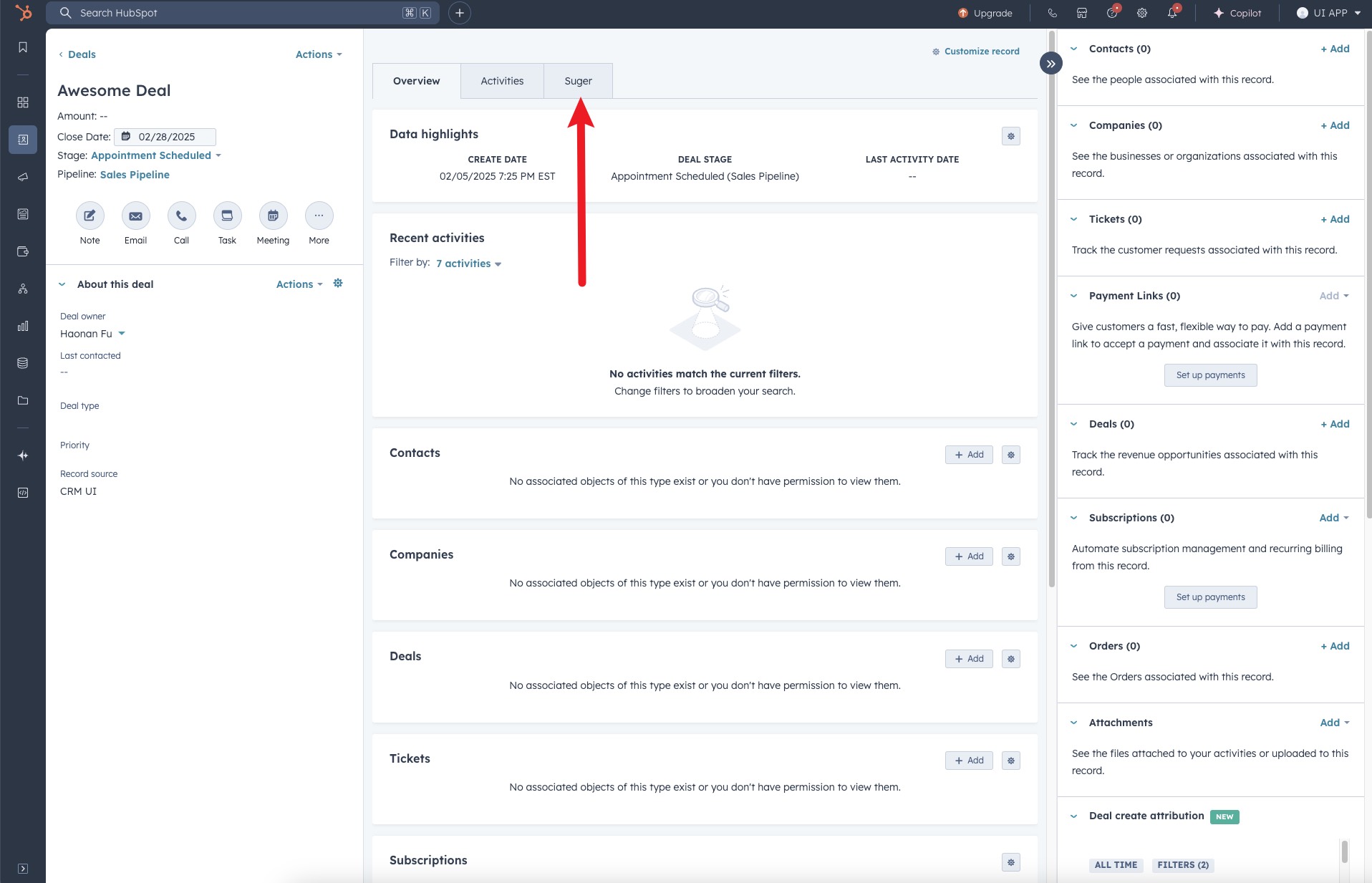
1. Navigate to the deal's detail page and click the **"Suger"** tab at the top of the page.
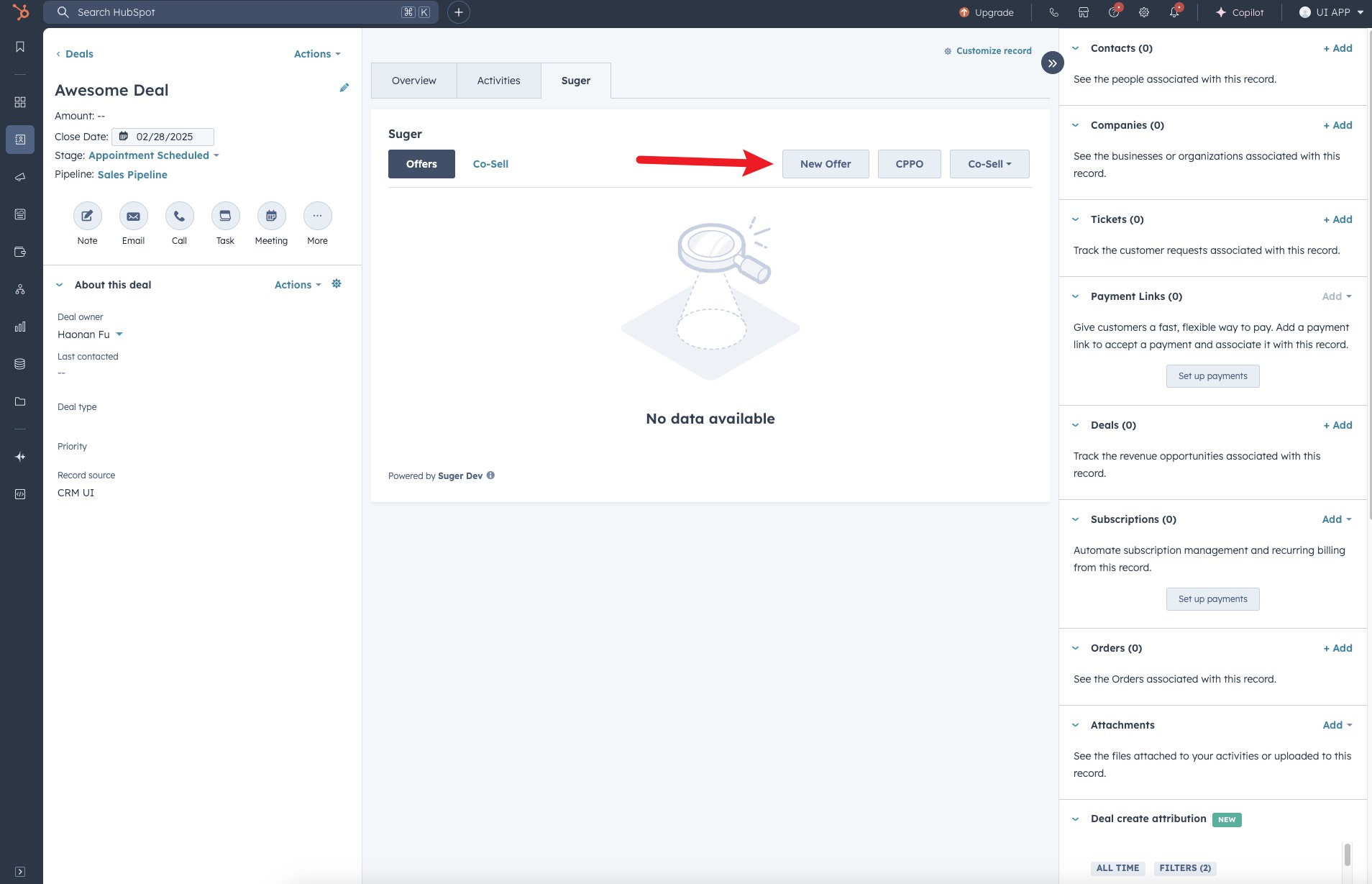
>  2. Locate and click the **"New Offer"** button.
>
2. Locate and click the **"New Offer"** button.
>  3. The **Create Private Offer** panel opens with **"Choose the type of offer you wish to create."** Pick one of the three types:
| Option | Use it when |
| --- | --- |
| **Private Offer** | You are sending a new negotiated offer directly to an end customer |
| **Amendment Offer** | You are changing an offer or agreement that already exists |
| **Reseller Offer** | You are creating the offer as a reseller, based on an authorization an ISV granted you |
:::tip
**Reseller Offer** here is the reseller side of the transaction. If you are the ISV authorizing a reseller to sell on your behalf, use the **New Resale** button instead — see [Create CPPO](/hubspot-app/hubspot-app-cppo/).
:::
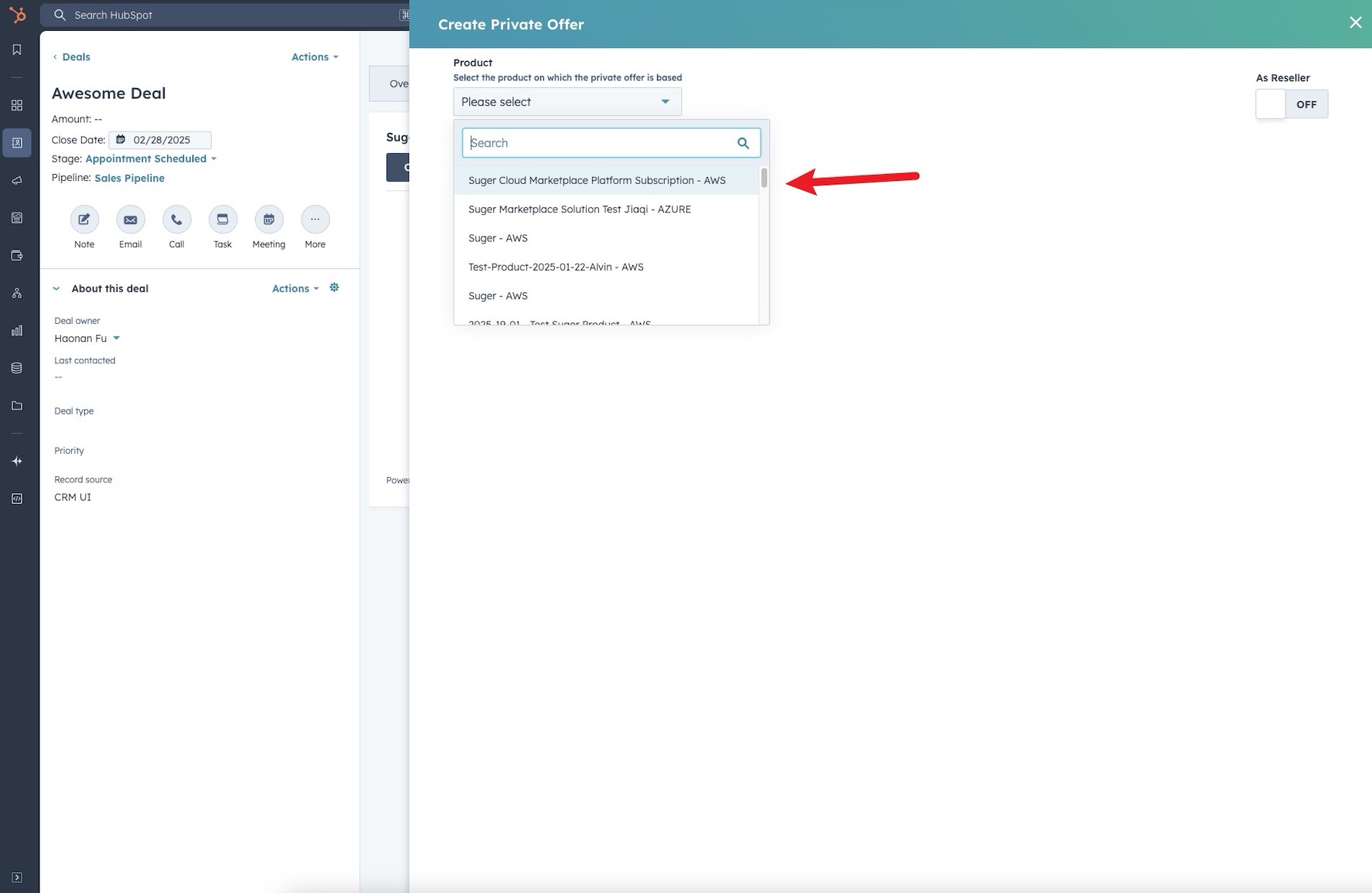
4. Choose the product on which the private offer will be based. The product list shows only products available in your Fours account.
>
3. The **Create Private Offer** panel opens with **"Choose the type of offer you wish to create."** Pick one of the three types:
| Option | Use it when |
| --- | --- |
| **Private Offer** | You are sending a new negotiated offer directly to an end customer |
| **Amendment Offer** | You are changing an offer or agreement that already exists |
| **Reseller Offer** | You are creating the offer as a reseller, based on an authorization an ISV granted you |
:::tip
**Reseller Offer** here is the reseller side of the transaction. If you are the ISV authorizing a reseller to sell on your behalf, use the **New Resale** button instead — see [Create CPPO](/hubspot-app/hubspot-app-cppo/).
:::
4. Choose the product on which the private offer will be based. The product list shows only products available in your Fours account.
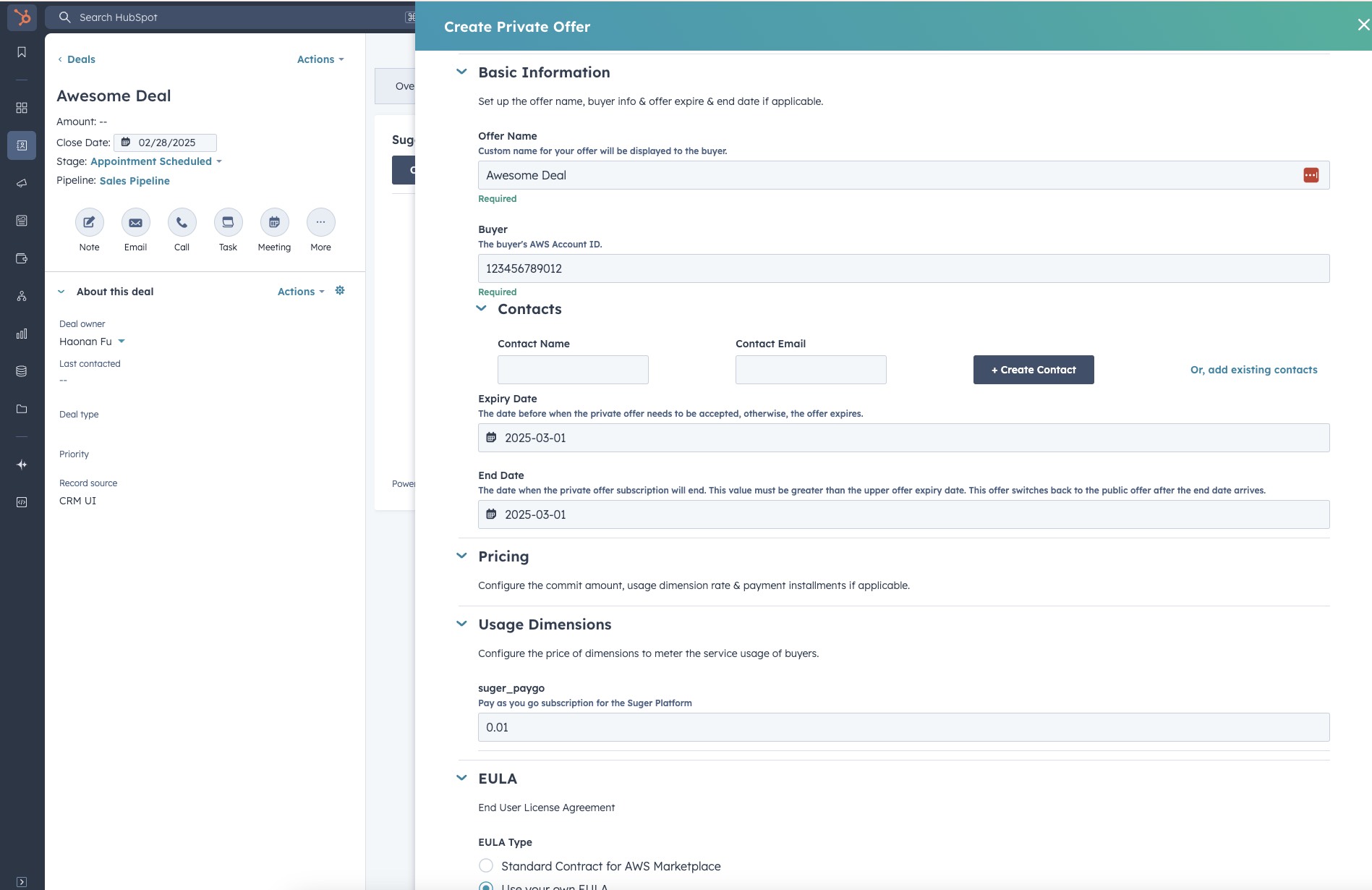
>  5. Complete the required fields in the form. Note that the required fields may vary depending on the cloud marketplace and the type of offer.
>
5. Complete the required fields in the form. Note that the required fields may vary depending on the cloud marketplace and the type of offer.
>  :::tip
If field mapping has been configured, the form will be prefilled with corresponding fields from the HubSpot deal, making the offer creation process faster and easier. Review the prefilled values for accuracy before submitting.
:::
6. Once all necessary information is filled in, submit the form to create the offer.
>
:::tip
If field mapping has been configured, the form will be prefilled with corresponding fields from the HubSpot deal, making the offer creation process faster and easier. Review the prefilled values for accuracy before submitting.
:::
6. Once all necessary information is filled in, submit the form to create the offer.
> 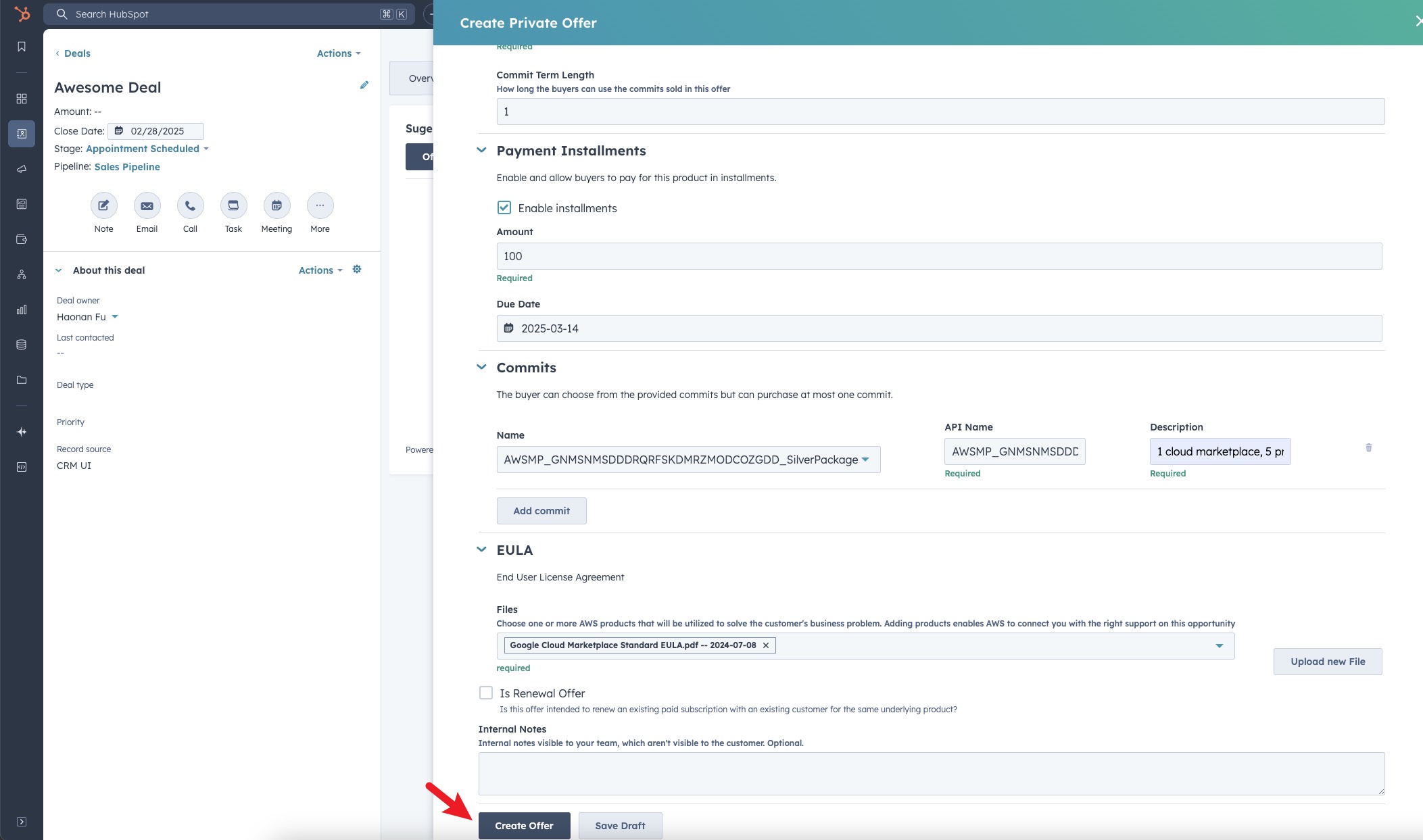 :::warning
After submitting, wait 3–5 minutes before copying the offer link. Fours sends the offer data to the cloud marketplace immediately, but the marketplace takes a few minutes to process it. The offer URL is not available until the marketplace confirms the offer. Refresh the offer record after a few minutes and the link will be ready.
:::
7. You are all set!
## Contacts on the offer
The AWS offer forms and the Azure private-offer forms (SaaS, Flat Rate, Per User and virtual machine products) have a **Contacts** section. Enter a **Contact Name** and **Contact Email** and click **+ Create Contact**, or click **Or, add existing contacts** and pick from the deal's HubSpot contacts in **Select Contacts**. The contacts are saved on the Fours offer, and Fours emails them only through the **Offer Notification Contacts** rule in your [email notification settings](/settings/email-notification/#email-an-offers-contacts).
On Azure these contacts replace the form's old **Notification contacts** list of email addresses, and they are not sent to Microsoft. The Azure **New Resale** forms keep their email list.
## AWS: buyer net payment term
Every AWS offer form — SaaS, agreement-based, container, machine learning, professional services, and
reseller — carries a **Buyer net payment term** field. It sets how long the buyer has to pay after being
invoiced.
Leave it on **Customer's net terms with AWS** and nothing changes: the buyer keeps whatever terms they
already have with AWS. Choose a custom term and you pick one of six:
| Option | |
| --- | --- |
| Net 15 days | Net 60 days |
| Net 30 days | Net 90 days |
| Net 45 days | Net 120 days |
:::warning
Use a custom term only after explicitly agreeing it with the buyer, and note three limits: it applies only
to **pay-by-invoice** buyers, AWS may charge a credit-card buyer immediately regardless, and **a released
term cannot be changed**. Longer terms also delay your own disbursement.
:::
Once the offer exists, the term is shown on the offer detail as **Buyer payment term**.
## AWS: pre-authorized renewal terms
The AWS SaaS, container and professional-services offer forms carry a **Configure renewal terms** section for [pre-authorized auto-renewal](/aws-marketplace/pre-authorized-auto-renewal/). It appears whenever the selected product has at least one commit (contract) dimension. A product that also meters usage qualifies too — only the commits matter.
- **Container offers** also need a committed pricing model. On a usage-based or free pricing model, or for a product that is free only, the section stays hidden.
- **AMI products never show it.** The container offer form also handles AMI products, and for them it leaves the section out: AWS offers no auto-renewal on an AMI product.
- **No commits, no renewal term.** If you switch to a product without commits, any renewal term the form was carrying — for example from a draft — is dropped, so it is never submitted.
What each renewal option means is covered in [Pre-Authorized Auto-Renewal](/aws-marketplace/pre-authorized-auto-renewal/). Once the buyer accepts, you manage the renewal from the deal's **Entitlements** tab — see [Adjust the renewal uplift](/hubspot-app/hubspot-app-entitlements/#adjust-the-renewal-uplift).
### Choose a renewal option
On a new offer the section starts on **No renewal**. Each option is a card of its own, and the fields for the option you pick open inside its card:
| Option | What it does |
| --- | --- |
| **No price uplift** | Renew at the same price each cycle. |
| **Price uplift** | Increase pricing each cycle by a **Fixed percentage** — the **Price increase percentage**, 0 to 100 — or within a **Percentage range** set by a **Minimum**, **Maximum** and **Default uplift percentage**. |
| **No renewal** | Do not include auto-renewal terms with this offer. |
**Percentage range** prefills a **Minimum** of 5%, a **Maximum** of 30% and a **Default uplift percentage** of 10%, so adjust the band to the one you agreed with the buyer. It also fills in the **Adjustment deadline** (**Days before agreement expiration**) with 30 days more than the renewal decision deadline — so the uplift is settled 30 days before the opt-out decision closes — or with 30 days when the renewal decision deadline is blank.
Both renewing options then ask for the **Renewal decision deadline**, the **Renewal count** — **Definite**, with a **Number of renewals**, or **Indefinite** — and an optional renewal payment schedule.
### Renewal decision deadline
**Renewal decision deadline (optional)** replaces the field that used to be called **Lockout period**. It is the number of days before the agreement expires after which neither party can opt out of the renewal. It opens empty: left blank, the deadline is the agreement expiration date. If you set it, it must be at least 1 day, and on a percentage range the adjustment deadline must be greater than it.
**Both deadlines must land inside the contract term.** Each is counted back from the end of the contract, and the form works out the calendar date it lands on. A deadline that falls outside the term stops the offer before it is sent, with an alert that names the date and the term — for example:
> *Renewal decision deadline (800 days) falls on 2025-07-23, which is not inside the contract term (2026-10-01 → 2027-10-01).*
The same check applies to the **Adjustment deadline**. The contract term is read from real dates: the term length — in days, months or years — added to the offer's start date, or the start and end dates when you set the term by dates. A 12-month term from 2026-10-01 ends on 2027-10-01, 365 days later. When the offer has no start date because its term starts when the buyer accepts, the term is counted from today.
:::warning
The check now runs on the SaaS, container and professional-services forms alike — the container and professional-services forms had none before. A saved draft whose deadline reaches outside its contract term now stops at the form until you shorten the deadline — such an offer used to be refused only after you submitted it.
:::
### Renewal payment schedule
**Enable renewal payment schedule** adds a schedule for invoicing each renewed term — optional, up to **86** installments, totaling 100%.
**Checking the box copies the offer's own installments.** Each installment you entered for the initial term becomes a row at the same point in the renewed term, with the same share of the total, and each row keeps its own day of the month — installments on 30 September, 31 December, 31 March and 30 June stay on those month ends. A few cases read differently:
- If two installments fall in the same calendar month, the rows are timed in exact days rather than months.
- Installments on the same date become one row.
- An offer with no installments starts from a single row: 100% at the agreement start.
While the schedule is still exactly what was copied, changing the offer's installments copies them again. Once you edit a row, your schedule is kept as you left it, and a draft reopened with a saved schedule keeps that schedule.
```d2
direction: right
unchecked: "Renewal payment\nschedule off"
seeded: "Filled from the\noffer's installments"
edited: "Kept as you\nedited it"
unchecked -> seeded: "check Enable renewal\npayment schedule"
seeded -> seeded: "installments change:\nfilled again"
seeded -> edited: "you edit a row"
seeded -> unchecked: "uncheck the box" {style.stroke-dash: 4}
edited -> unchecked: "uncheck the box" {style.stroke-dash: 4}
```
Each row has:
| Field | What it holds |
| --- | --- |
| **Months after agreement start** or **Days after agreement start** | When the installment is due. The timing in words sits underneath — for example *Agreement start date*, *Month 3 of the agreement* or *45 days after the agreement starts*. |
| **Day of month (optional)** | The billing day, on a schedule timed in months |
| **Percentage of TCV** | The row's share, 0.01 to 100 with at most two decimal places |
| **Estimated first renewal cycle payment amount** | Shown when the offer's installments carry amounts: the row's share of the first renewal cycle — the contract total after one cycle of uplift, at the fixed percentage or the range's default — in the offer's currency. The rows add up exactly to that cycle's total. |
When the installments carry amounts, **Original contract total** and **Contract duration** appear above the rows — the figures the rows are priced against. The duration reads, for example, *12 months · 365 days*, or *12 months · Starts when the buyer accepts* for an offer whose term starts on acceptance.
- **Due date calculation** — **By month** or **By exact days** — sets the unit for the whole schedule; rows no longer carry a unit of their own. Switching it converts every row at 30 days to a month.
- **Renewal Payment Scheduler** generates equal installments from a **Payment frequency** (Monthly, Quarterly, Semi-annually, Annually or Custom), a **Due date calculation**, a **Number of installments** (up to 86) and, when timed by month, an optional **Day of month**. Check the **Plan preview**, then click **Create** to replace the rows.
- **New payment installment** adds a single row. Underneath, the schedule counts its installments and shows the **Allocated** and **Remaining** percentages.
## Azure: automatic subscription activation
An Azure SaaS offer form carries **Automatically activate the subscription on purchase**.
- **Checked** — Azure activates the SaaS subscription automatically once the customer purchases the offer.
- **Unchecked** — your team activates it.
The checkbox appears only when your Azure integration is set to **self-managed subscription activation** and the offer uses **V2 pricing**. On any other combination it is hidden, because the setting cannot be carried on the offer at all. See [Azure Marketplace integration settings](/azure-marketplace/integration/).
## Azure: custom contract terms and renewal
On an Azure offer, the **Contract Duration** toggle includes a **Custom** option. Choosing it reveals two more fields:
- **Custom Duration Unit** — months or years.
- **Custom Duration Value** — the length. The helper text is *"1–120 months or 1–10 years; month values divisible by 12 must use years"*, so a 24-month term has to be entered as 2 years.
A custom term also makes **Renewal Behavior** required, and its "no renewal" option is hidden — Azure will not accept a custom-term offer without a renewal decision. The options are:
| Renewal Behavior | What happens at the end of the term |
| --- | --- |
| **No renewal configured** | The subscription does not renew. Not available when the term is custom |
| **Renew into private offer** | The customer rolls into the private offer pricing again |
| **Renew into public offer** | The customer rolls onto your public marketplace listing pricing |
When you pick a renewal that continues the subscription, set **Renewal Contract Duration** and **Renewal Billing Frequency** underneath it.
Two defaults are worth knowing, because they changed:
- Choosing **Custom** now pre-selects **Renew into public offer**. If you want the customer to roll into the
private pricing again, change it yourself — the form no longer assumes it.
- **Renewal Contract Duration** is seeded with the **shortest** published term on your base plan, and the
dropdown is ordered shortest first.
## GCP: usage plan pricing model
When the plan you pick for a GCP offer is a usage plan, the form asks for a **Usage Plan Pricing Model**. Until you choose one, its description reads *"Select the pricing model for the usage plan."* Once you do, the description shows the hint GCP's Producer Portal gives for that model:
| Usage Plan Pricing Model | Description once selected |
| --- | --- |
| **Commitment discount with additional usage at list price** | *The customer promises to pay a discounted amount. All usage, including overages, is list price.* |
| **Commitment with all usage discounted** | *The customer promises to pay an amount. All usage, including overages, is discounted.* |
| **Usage-based discount only** | *The customer pays a discounted amount for what they use* |
The field appears on every GCP form that prices a usage plan: a **Private Offer**, an **Amendment Offer**, and a resale authorization created with **New Resale**. On an amendment, keep the model of the offer you are replacing — GCP refuses an amendment that changes it. The form fills the model in from that offer when it can; if the field is empty, choose the model the original offer uses. How each model charges for usage is explained in [Usage-Based Offers](/gcp-marketplace/create-private-offer/#usage-based-offers).
## GCP: expiry within three months
Google Cloud Marketplace requires an offer to expire within three months. On a GCP offer that limit applies to the **Expiry Date**, and on a GCP resale authorization to the **Acceptance Due Date**. The date picker still lets you choose a later date, but Fours refuses the offer when you submit it, before anything is sent to Google, and the error alert names the date you picked and the last one you can use — for example:
> *the offer expiration date (January 5, 2027) is too late. Google Cloud Marketplace requires offers to expire within 3 months, so choose a date on or before December 22, 2026*
Pick that date or an earlier one and submit again. Saving a draft does not check the date; the check runs when you submit. How the last allowed date is worked out is covered in [Set pricing information](/gcp-marketplace/create-private-offer/#step-3-set-pricing-information).
## Manage an offer after it is created
Each row in the **Offers** tab has an actions menu:
| Action | What it does |
| --- | --- |
| **Cancel Offer** | Cancels the offer so the buyer can no longer accept it |
| **Extend Expiry Date** | Pushes the offer's expiry date out |
| **Edit Offer Info** | Edits the offer's descriptive information |
| **Clone Offer** | Starts a new offer pre-populated from this one. Not available on resale authorizations (`CPPO`) or on an incoming reseller offer (`CPPO_IN`) |
| **Edit draft** | Reopens an offer that never reached the marketplace so you can correct and resubmit it. Shown on `DRAFT`, `CREATE_FAILED`, and `INVALID` offers |
### When Extend Expiry Date is available
**Extend Expiry Date** is offered when the offer's status is one of:
| Status | Why it is extendable |
| --- | --- |
| **PENDING_ACCEPTANCE** | The buyer has not accepted yet and needs more time |
| **EXPIRED** | The offer lapsed and you want to revive it |
| **UPDATE_FAILED** | A previous extend attempt failed — extend again to retry it |
It is never available in these cases:
- **CPPO offers.** A CPPO is created and owned by the reseller, so the ISV cannot extend it.
- **AWS resale authorizations (CPPO_OUT).** AWS does not support extending an authorization.
- **Azure offers on v1 pricing.** Only v2 and v3 Azure pricing can be extended.
- **Azure resale authorizations.** They have no expiry date to extend — see [Azure: grant a resale authorization](/hubspot-app/hubspot-app-cppo/#azure-grant-a-resale-authorization).
## GCP: replaced offers
When a GCP offer replaces an earlier one, the offer detail shows **Replaced Offer ID** — the identifier of the offer it supersedes. Once Fours resolves that identifier, a **Replaced Offer** row appears with the replaced offer's name, so you can see at a glance which offer this one took over from.
## GCP: dates in Pacific time
On a GCP offer's detail, **Start Date**, **Expire Date**, **Accept Date** and **End Date** show a date and time in Pacific time, with PST or PDT — for example *8/31/2026, 11:45:00 PM PDT* — rather than a UTC date. Pacific time is the calendar GCP Marketplace keeps, so the dates line up with GCP's Producer Portal.
Fours also counts a GCP term from the Pacific calendar day it starts on. An offer whose term starts when the buyer accepts, and that was accepted in the Pacific evening, no longer shows an end date one day later than the Producer Portal.
The **Offers** table still lists **Create (UTC)** and **Expire (UTC)** in UTC, so a GCP offer's expiry can read one day later there than in the offer detail.
## What happens next
After you submit the offer:
- Fours creates the offer and links it to the HubSpot deal.
- The offer is sent to the cloud marketplace for processing.
- Once the marketplace confirms the offer, the offer status updates and the offer URL becomes available.
- Copy the offer URL and send it to the buyer — they use it to review and accept the offer in their cloud marketplace account.
- The offer is also visible in the Fours Console under your offers list.
## Troubleshooting common issues
| Issue | Possible cause | Resolution |
| --- | --- | --- |
| No Suger tab visible on the deal page | The Fours app card has not been added to the deal layout | Follow [Configuration](/hubspot-app/hubspot-app-configuration/) to add the app card |
| No New Offer button visible inside the Suger panel | The HubSpot integration connection has been disrupted | Go to Fours Console → Settings → Integrations → HubSpot and click Verify to re-verify the connection |
| Product list is empty | No products have been set up in Fours | Confirm that products exist in the Fours Console before creating an offer |
| Form fields are blank — not pre-filled from the deal | Field mapping has not been configured | Field mapping is an optional admin setup. Contact your admin to configure it |
| Offer URL is not available after the offer is created | The marketplace has not finished processing the offer yet | Wait 3–5 minutes and refresh the page. The URL appears once the marketplace confirms the offer |
| An error alert says *the offer expiration date (…) is too late* when you submit a GCP offer | The **Expiry Date** is more than three months away, which Google Cloud Marketplace does not accept | Pick the date the message names, or an earlier one, and submit again — see [GCP: expiry within three months](#gcp-expiry-within-three-months) |
| Offer was created but is not visible on the deal | Sync between Fours and HubSpot is delayed | Refresh the page after a few minutes. If it still doesn't appear, confirm the offer was created successfully in the Fours Console |
## Frequently asked questions
**Can I create offers for AWS, Azure, and GCP from HubSpot?**
Yes — as long as products are set up for each cloud in Fours. The product selector in the offer form shows all available products across clouds.
**What is field mapping and do I need it?**
Field mapping is an optional configuration that automatically pre-fills offer form fields with data from the HubSpot deal — like company name, deal value, or close date. It saves time and reduces manual entry errors. You can still create offers without it, but you'll need to fill in all fields manually.
**Will the offer show up in the Fours Console too?**
Yes. Any offer created from HubSpot is also visible in the Fours Console under your offers list.
**The buyer can't find the offer link. What do I do?**
Open the offer in HubSpot or in the Fours Console and copy the offer URL directly. Make sure at least 3–5 minutes have passed since the offer was created — the URL is not available until the marketplace confirms it.
:::warning
After submitting, wait 3–5 minutes before copying the offer link. Fours sends the offer data to the cloud marketplace immediately, but the marketplace takes a few minutes to process it. The offer URL is not available until the marketplace confirms the offer. Refresh the offer record after a few minutes and the link will be ready.
:::
7. You are all set!
## Contacts on the offer
The AWS offer forms and the Azure private-offer forms (SaaS, Flat Rate, Per User and virtual machine products) have a **Contacts** section. Enter a **Contact Name** and **Contact Email** and click **+ Create Contact**, or click **Or, add existing contacts** and pick from the deal's HubSpot contacts in **Select Contacts**. The contacts are saved on the Fours offer, and Fours emails them only through the **Offer Notification Contacts** rule in your [email notification settings](/settings/email-notification/#email-an-offers-contacts).
On Azure these contacts replace the form's old **Notification contacts** list of email addresses, and they are not sent to Microsoft. The Azure **New Resale** forms keep their email list.
## AWS: buyer net payment term
Every AWS offer form — SaaS, agreement-based, container, machine learning, professional services, and
reseller — carries a **Buyer net payment term** field. It sets how long the buyer has to pay after being
invoiced.
Leave it on **Customer's net terms with AWS** and nothing changes: the buyer keeps whatever terms they
already have with AWS. Choose a custom term and you pick one of six:
| Option | |
| --- | --- |
| Net 15 days | Net 60 days |
| Net 30 days | Net 90 days |
| Net 45 days | Net 120 days |
:::warning
Use a custom term only after explicitly agreeing it with the buyer, and note three limits: it applies only
to **pay-by-invoice** buyers, AWS may charge a credit-card buyer immediately regardless, and **a released
term cannot be changed**. Longer terms also delay your own disbursement.
:::
Once the offer exists, the term is shown on the offer detail as **Buyer payment term**.
## AWS: pre-authorized renewal terms
The AWS SaaS, container and professional-services offer forms carry a **Configure renewal terms** section for [pre-authorized auto-renewal](/aws-marketplace/pre-authorized-auto-renewal/). It appears whenever the selected product has at least one commit (contract) dimension. A product that also meters usage qualifies too — only the commits matter.
- **Container offers** also need a committed pricing model. On a usage-based or free pricing model, or for a product that is free only, the section stays hidden.
- **AMI products never show it.** The container offer form also handles AMI products, and for them it leaves the section out: AWS offers no auto-renewal on an AMI product.
- **No commits, no renewal term.** If you switch to a product without commits, any renewal term the form was carrying — for example from a draft — is dropped, so it is never submitted.
What each renewal option means is covered in [Pre-Authorized Auto-Renewal](/aws-marketplace/pre-authorized-auto-renewal/). Once the buyer accepts, you manage the renewal from the deal's **Entitlements** tab — see [Adjust the renewal uplift](/hubspot-app/hubspot-app-entitlements/#adjust-the-renewal-uplift).
### Choose a renewal option
On a new offer the section starts on **No renewal**. Each option is a card of its own, and the fields for the option you pick open inside its card:
| Option | What it does |
| --- | --- |
| **No price uplift** | Renew at the same price each cycle. |
| **Price uplift** | Increase pricing each cycle by a **Fixed percentage** — the **Price increase percentage**, 0 to 100 — or within a **Percentage range** set by a **Minimum**, **Maximum** and **Default uplift percentage**. |
| **No renewal** | Do not include auto-renewal terms with this offer. |
**Percentage range** prefills a **Minimum** of 5%, a **Maximum** of 30% and a **Default uplift percentage** of 10%, so adjust the band to the one you agreed with the buyer. It also fills in the **Adjustment deadline** (**Days before agreement expiration**) with 30 days more than the renewal decision deadline — so the uplift is settled 30 days before the opt-out decision closes — or with 30 days when the renewal decision deadline is blank.
Both renewing options then ask for the **Renewal decision deadline**, the **Renewal count** — **Definite**, with a **Number of renewals**, or **Indefinite** — and an optional renewal payment schedule.
### Renewal decision deadline
**Renewal decision deadline (optional)** replaces the field that used to be called **Lockout period**. It is the number of days before the agreement expires after which neither party can opt out of the renewal. It opens empty: left blank, the deadline is the agreement expiration date. If you set it, it must be at least 1 day, and on a percentage range the adjustment deadline must be greater than it.
**Both deadlines must land inside the contract term.** Each is counted back from the end of the contract, and the form works out the calendar date it lands on. A deadline that falls outside the term stops the offer before it is sent, with an alert that names the date and the term — for example:
> *Renewal decision deadline (800 days) falls on 2025-07-23, which is not inside the contract term (2026-10-01 → 2027-10-01).*
The same check applies to the **Adjustment deadline**. The contract term is read from real dates: the term length — in days, months or years — added to the offer's start date, or the start and end dates when you set the term by dates. A 12-month term from 2026-10-01 ends on 2027-10-01, 365 days later. When the offer has no start date because its term starts when the buyer accepts, the term is counted from today.
:::warning
The check now runs on the SaaS, container and professional-services forms alike — the container and professional-services forms had none before. A saved draft whose deadline reaches outside its contract term now stops at the form until you shorten the deadline — such an offer used to be refused only after you submitted it.
:::
### Renewal payment schedule
**Enable renewal payment schedule** adds a schedule for invoicing each renewed term — optional, up to **86** installments, totaling 100%.
**Checking the box copies the offer's own installments.** Each installment you entered for the initial term becomes a row at the same point in the renewed term, with the same share of the total, and each row keeps its own day of the month — installments on 30 September, 31 December, 31 March and 30 June stay on those month ends. A few cases read differently:
- If two installments fall in the same calendar month, the rows are timed in exact days rather than months.
- Installments on the same date become one row.
- An offer with no installments starts from a single row: 100% at the agreement start.
While the schedule is still exactly what was copied, changing the offer's installments copies them again. Once you edit a row, your schedule is kept as you left it, and a draft reopened with a saved schedule keeps that schedule.
```d2
direction: right
unchecked: "Renewal payment\nschedule off"
seeded: "Filled from the\noffer's installments"
edited: "Kept as you\nedited it"
unchecked -> seeded: "check Enable renewal\npayment schedule"
seeded -> seeded: "installments change:\nfilled again"
seeded -> edited: "you edit a row"
seeded -> unchecked: "uncheck the box" {style.stroke-dash: 4}
edited -> unchecked: "uncheck the box" {style.stroke-dash: 4}
```
Each row has:
| Field | What it holds |
| --- | --- |
| **Months after agreement start** or **Days after agreement start** | When the installment is due. The timing in words sits underneath — for example *Agreement start date*, *Month 3 of the agreement* or *45 days after the agreement starts*. |
| **Day of month (optional)** | The billing day, on a schedule timed in months |
| **Percentage of TCV** | The row's share, 0.01 to 100 with at most two decimal places |
| **Estimated first renewal cycle payment amount** | Shown when the offer's installments carry amounts: the row's share of the first renewal cycle — the contract total after one cycle of uplift, at the fixed percentage or the range's default — in the offer's currency. The rows add up exactly to that cycle's total. |
When the installments carry amounts, **Original contract total** and **Contract duration** appear above the rows — the figures the rows are priced against. The duration reads, for example, *12 months · 365 days*, or *12 months · Starts when the buyer accepts* for an offer whose term starts on acceptance.
- **Due date calculation** — **By month** or **By exact days** — sets the unit for the whole schedule; rows no longer carry a unit of their own. Switching it converts every row at 30 days to a month.
- **Renewal Payment Scheduler** generates equal installments from a **Payment frequency** (Monthly, Quarterly, Semi-annually, Annually or Custom), a **Due date calculation**, a **Number of installments** (up to 86) and, when timed by month, an optional **Day of month**. Check the **Plan preview**, then click **Create** to replace the rows.
- **New payment installment** adds a single row. Underneath, the schedule counts its installments and shows the **Allocated** and **Remaining** percentages.
## Azure: automatic subscription activation
An Azure SaaS offer form carries **Automatically activate the subscription on purchase**.
- **Checked** — Azure activates the SaaS subscription automatically once the customer purchases the offer.
- **Unchecked** — your team activates it.
The checkbox appears only when your Azure integration is set to **self-managed subscription activation** and the offer uses **V2 pricing**. On any other combination it is hidden, because the setting cannot be carried on the offer at all. See [Azure Marketplace integration settings](/azure-marketplace/integration/).
## Azure: custom contract terms and renewal
On an Azure offer, the **Contract Duration** toggle includes a **Custom** option. Choosing it reveals two more fields:
- **Custom Duration Unit** — months or years.
- **Custom Duration Value** — the length. The helper text is *"1–120 months or 1–10 years; month values divisible by 12 must use years"*, so a 24-month term has to be entered as 2 years.
A custom term also makes **Renewal Behavior** required, and its "no renewal" option is hidden — Azure will not accept a custom-term offer without a renewal decision. The options are:
| Renewal Behavior | What happens at the end of the term |
| --- | --- |
| **No renewal configured** | The subscription does not renew. Not available when the term is custom |
| **Renew into private offer** | The customer rolls into the private offer pricing again |
| **Renew into public offer** | The customer rolls onto your public marketplace listing pricing |
When you pick a renewal that continues the subscription, set **Renewal Contract Duration** and **Renewal Billing Frequency** underneath it.
Two defaults are worth knowing, because they changed:
- Choosing **Custom** now pre-selects **Renew into public offer**. If you want the customer to roll into the
private pricing again, change it yourself — the form no longer assumes it.
- **Renewal Contract Duration** is seeded with the **shortest** published term on your base plan, and the
dropdown is ordered shortest first.
## GCP: usage plan pricing model
When the plan you pick for a GCP offer is a usage plan, the form asks for a **Usage Plan Pricing Model**. Until you choose one, its description reads *"Select the pricing model for the usage plan."* Once you do, the description shows the hint GCP's Producer Portal gives for that model:
| Usage Plan Pricing Model | Description once selected |
| --- | --- |
| **Commitment discount with additional usage at list price** | *The customer promises to pay a discounted amount. All usage, including overages, is list price.* |
| **Commitment with all usage discounted** | *The customer promises to pay an amount. All usage, including overages, is discounted.* |
| **Usage-based discount only** | *The customer pays a discounted amount for what they use* |
The field appears on every GCP form that prices a usage plan: a **Private Offer**, an **Amendment Offer**, and a resale authorization created with **New Resale**. On an amendment, keep the model of the offer you are replacing — GCP refuses an amendment that changes it. The form fills the model in from that offer when it can; if the field is empty, choose the model the original offer uses. How each model charges for usage is explained in [Usage-Based Offers](/gcp-marketplace/create-private-offer/#usage-based-offers).
## GCP: expiry within three months
Google Cloud Marketplace requires an offer to expire within three months. On a GCP offer that limit applies to the **Expiry Date**, and on a GCP resale authorization to the **Acceptance Due Date**. The date picker still lets you choose a later date, but Fours refuses the offer when you submit it, before anything is sent to Google, and the error alert names the date you picked and the last one you can use — for example:
> *the offer expiration date (January 5, 2027) is too late. Google Cloud Marketplace requires offers to expire within 3 months, so choose a date on or before December 22, 2026*
Pick that date or an earlier one and submit again. Saving a draft does not check the date; the check runs when you submit. How the last allowed date is worked out is covered in [Set pricing information](/gcp-marketplace/create-private-offer/#step-3-set-pricing-information).
## Manage an offer after it is created
Each row in the **Offers** tab has an actions menu:
| Action | What it does |
| --- | --- |
| **Cancel Offer** | Cancels the offer so the buyer can no longer accept it |
| **Extend Expiry Date** | Pushes the offer's expiry date out |
| **Edit Offer Info** | Edits the offer's descriptive information |
| **Clone Offer** | Starts a new offer pre-populated from this one. Not available on resale authorizations (`CPPO`) or on an incoming reseller offer (`CPPO_IN`) |
| **Edit draft** | Reopens an offer that never reached the marketplace so you can correct and resubmit it. Shown on `DRAFT`, `CREATE_FAILED`, and `INVALID` offers |
### When Extend Expiry Date is available
**Extend Expiry Date** is offered when the offer's status is one of:
| Status | Why it is extendable |
| --- | --- |
| **PENDING_ACCEPTANCE** | The buyer has not accepted yet and needs more time |
| **EXPIRED** | The offer lapsed and you want to revive it |
| **UPDATE_FAILED** | A previous extend attempt failed — extend again to retry it |
It is never available in these cases:
- **CPPO offers.** A CPPO is created and owned by the reseller, so the ISV cannot extend it.
- **AWS resale authorizations (CPPO_OUT).** AWS does not support extending an authorization.
- **Azure offers on v1 pricing.** Only v2 and v3 Azure pricing can be extended.
- **Azure resale authorizations.** They have no expiry date to extend — see [Azure: grant a resale authorization](/hubspot-app/hubspot-app-cppo/#azure-grant-a-resale-authorization).
## GCP: replaced offers
When a GCP offer replaces an earlier one, the offer detail shows **Replaced Offer ID** — the identifier of the offer it supersedes. Once Fours resolves that identifier, a **Replaced Offer** row appears with the replaced offer's name, so you can see at a glance which offer this one took over from.
## GCP: dates in Pacific time
On a GCP offer's detail, **Start Date**, **Expire Date**, **Accept Date** and **End Date** show a date and time in Pacific time, with PST or PDT — for example *8/31/2026, 11:45:00 PM PDT* — rather than a UTC date. Pacific time is the calendar GCP Marketplace keeps, so the dates line up with GCP's Producer Portal.
Fours also counts a GCP term from the Pacific calendar day it starts on. An offer whose term starts when the buyer accepts, and that was accepted in the Pacific evening, no longer shows an end date one day later than the Producer Portal.
The **Offers** table still lists **Create (UTC)** and **Expire (UTC)** in UTC, so a GCP offer's expiry can read one day later there than in the offer detail.
## What happens next
After you submit the offer:
- Fours creates the offer and links it to the HubSpot deal.
- The offer is sent to the cloud marketplace for processing.
- Once the marketplace confirms the offer, the offer status updates and the offer URL becomes available.
- Copy the offer URL and send it to the buyer — they use it to review and accept the offer in their cloud marketplace account.
- The offer is also visible in the Fours Console under your offers list.
## Troubleshooting common issues
| Issue | Possible cause | Resolution |
| --- | --- | --- |
| No Suger tab visible on the deal page | The Fours app card has not been added to the deal layout | Follow [Configuration](/hubspot-app/hubspot-app-configuration/) to add the app card |
| No New Offer button visible inside the Suger panel | The HubSpot integration connection has been disrupted | Go to Fours Console → Settings → Integrations → HubSpot and click Verify to re-verify the connection |
| Product list is empty | No products have been set up in Fours | Confirm that products exist in the Fours Console before creating an offer |
| Form fields are blank — not pre-filled from the deal | Field mapping has not been configured | Field mapping is an optional admin setup. Contact your admin to configure it |
| Offer URL is not available after the offer is created | The marketplace has not finished processing the offer yet | Wait 3–5 minutes and refresh the page. The URL appears once the marketplace confirms the offer |
| An error alert says *the offer expiration date (…) is too late* when you submit a GCP offer | The **Expiry Date** is more than three months away, which Google Cloud Marketplace does not accept | Pick the date the message names, or an earlier one, and submit again — see [GCP: expiry within three months](#gcp-expiry-within-three-months) |
| Offer was created but is not visible on the deal | Sync between Fours and HubSpot is delayed | Refresh the page after a few minutes. If it still doesn't appear, confirm the offer was created successfully in the Fours Console |
## Frequently asked questions
**Can I create offers for AWS, Azure, and GCP from HubSpot?**
Yes — as long as products are set up for each cloud in Fours. The product selector in the offer form shows all available products across clouds.
**What is field mapping and do I need it?**
Field mapping is an optional configuration that automatically pre-fills offer form fields with data from the HubSpot deal — like company name, deal value, or close date. It saves time and reduces manual entry errors. You can still create offers without it, but you'll need to fill in all fields manually.
**Will the offer show up in the Fours Console too?**
Yes. Any offer created from HubSpot is also visible in the Fours Console under your offers list.
**The buyer can't find the offer link. What do I do?**
Open the offer in HubSpot or in the Fours Console and copy the offer URL directly. Make sure at least 3–5 minutes have passed since the offer was created — the URL is not available until the marketplace confirms it.