# Configuration
A co-sell configuration translates between your CRM and one cloud partner. It decides how a CRM record becomes a referral, which fields keep syncing, and how a partner's referral is written back into your CRM. Set it up once, and your team shares and tracks referrals without re-entering data in each partner portal.
Configurations apply to the Fours Console and to the Fours app in your CRM. Click  **History** at any time to see who changed what. The button is in the **Cosell Configs** header (**Co-Sell › Settings › Configs**). It opens a timestamped log of every configuration change, with who made it.
**Before you start:**
- You need admin access in the Fours Console. Configuration is on the **Settings** tab of the **Co-Sell** page ([open it](https://console.suger.io/cosell?tab=settings)).
- Connect your CRM (Salesforce, HubSpot or Dynamics 365) under **Settings › Integrations**.
- Connect your cloud partner under **Settings › Integrations**: [AWS](/integrations/aws-partner-network-api/), [Azure](/integrations/azure-cosell/) or [Google Cloud](/integrations/gcp-cosell/).
**Related pages:**
- [Referral Automations](/cosell/setup/automations/): auto-share, auto-enrich, auto-accept and the other switches on a configuration.
- [Referral Syncing](/cosell/referrals/syncing/): how often each direction syncs.
## Create a new configuration
Each configuration is a dedicated bridge between one CRM source and one cloud partner network.
1. Open the **Co-Sell** page and select its **Settings** tab
([open it](https://console.suger.io/cosell?tab=settings§ion=configs)).
2. Select the **Configs** sub-tab, and click the `New Config` button in the **Cosell Configs**
header.
>
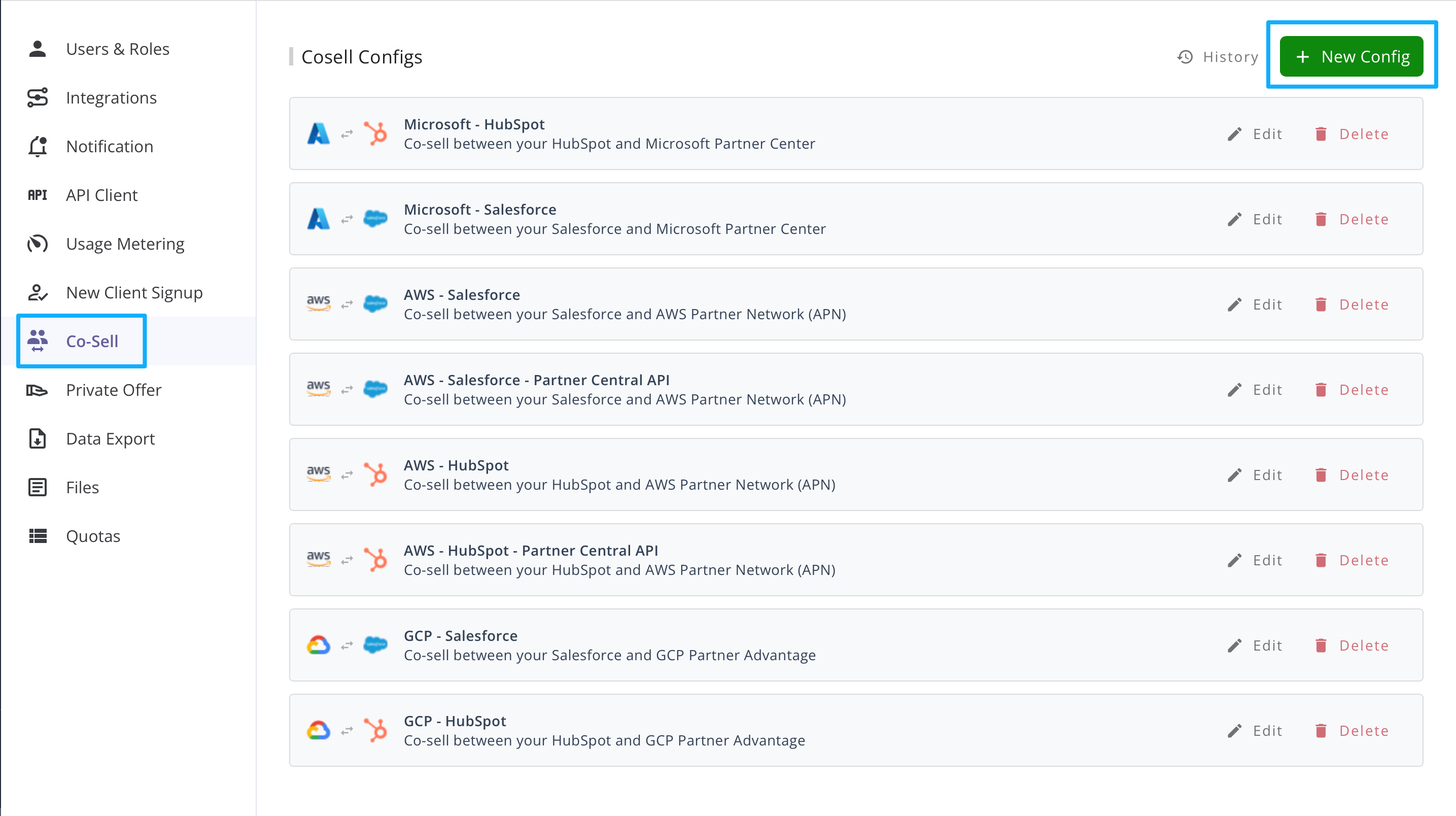 3. Choose the **CRM Partner** and the **Cloud Partner** to proceed.
| Picker | Options |
| --- | --- |
| **CRM Partner** | `SALESFORCE`, `HUBSPOT`, `DYNAMICS365` |
| **Cloud Partner** | `AWS`, `AZURE`, `GCP`, and `SUGER` |
Each picker lists only the partners your organization has actually connected, so a CRM or
cloud you have not integrated does not appear. `SUGER` is offered as a cloud partner only
when Partner Management (PRM) is enabled for your organization.
:::warning
Only one active configuration is allowed per hyperscaler (e.g., one for AWS, one for GCP). You can't run two AWS configs side by side, even across different CRMs. To change an existing configuration, edit it rather than creating a second one.
:::
## Outbound Setting
Outbound covers data **from your CRM to the cloud partner**.
### Field Mapping
Field mapping configuration is used to control how fields are pre-filled when you create a new referral share from CRM to Cloud Partners. [Auto-share](/cosell/setup/automations/#auto-share-referrals) uses it too.
It also applies to the Fours app in your CRM.
In the configuration table, the title of each row represents the field name in the Cloud Partner. You can use the search dropdown to select which CRM field should be mapped to it.
You can add or remove Cloud Partner fields to customize your own mapping rules.
Each row is labelled with the partner's field name, with the field's API path beneath it. On
**AWS** and **Azure** configurations the rows are grouped into sections you can collapse — on AWS,
*Customer information*, *Project information*, *Contacts*, *Lifecycle & revenue*, and *Software
revenue & contract terms*. Each section heading counts its rows and, when some need fixing, how
many are left to review, for example **Contacts (6 · 1 to review)**. Drag a row by its handle
(**Drag to reorder**) to move it; on AWS and Azure a row can only move within its own section. GCP
and Fours partner (`SUGER`) configurations show one list.
Some fields may be marked with an asterisk (*), which means they are required fields and must be filled in before submission.
Use **Formula** to define complex data-mapping rules, including conditional logic, value conversions, and cross-field mappings, and **Picklist** to translate a CRM field's values into the partner's own values.
See [Formulas (Expression Mode)](#formulas-expression-mode) and [Picklist Value Mapping](#picklist-value-mapping) for detailed documentation and examples.
For each partner field, choose where its value comes from. Each row offers up to four
value-source buttons — **Default**, **Formula**, **Picklist** (only on fields with a fixed list of
values) and **AI** (only on fields that support it). Leave all of them off to map the field
directly from the CRM field you pick. [Inbound](#objects-tab) rows work the same way. If you switch a row to
another source and back before you save, it comes back as you left it; only the source that is
active when you save is kept.
| Value source | Use case | Example |
| --- | --- | --- |
| **CRM field** (no button pressed) | Links a CRM field 1:1 to a partner field. Best for standard fields like Close Date. | `Opportunity.CloseDate` → `Partner.Target_Close_Date` |
| **Default Value** (**Default**) | A hard-coded value sent for every referral. Best for information that's mandatory for the partner but identical across your company — Partner ID, alliances team alias, sales-lead email, listing ID. | `Sales_Lead_Email` → `alliances@company.com` |
| **Picklist** | Maps each value of a CRM field to one of the partner's values. Best for dropdowns, such as aligning deal stages to partner stages — map every active CRM value to a partner-approved value. See [Picklist Value Mapping](#picklist-value-mapping). | `Discovery` → `Prospecting` |
| **Formula** (Expression Mode) | A dynamic logic engine using Go Templates (`text/template`) syntax — calculations, concatenations, fallbacks, and cross-field lookups. Build one from a recipe, or write the template yourself. | `{{- multiply .Amount 0.8 -}}` (net revenue) or `{{.Name}} {{.Account.Name}}` (unique title) |
| **AI Generate** (**AI**) | Describe the value you want in a natural-language prompt and Fours generates it with AI when the referral is shared. You can reference source fields with `{{.FieldName}}`. Available on five supported AWS ACE fields: Industry Vertical, Partner Primary Need from AWS, Postal Code, Customer Business Problem, and Estimated AWS Monthly Recurring Revenue. | `Write a business problem statement based on {{.Description}}` |
:::info
For the **Customer Business Problem** field, Fours automatically instructs the AI to produce 500–1,800 characters and truncates any output over 1,800 characters. The built-in rule takes precedence over any other length guidance in the AI prompt.
:::
:::warning
You must map every active CRM stage (e.g., "Discovery") to a partner-approved value (e.g., "Prospecting"), or the sync will fail during stage transitions.
:::

#### Items that need attention
Every outbound configuration shows a summary line above its field list that says whether the
partner would refuse a referral built from this mapping. When it wouldn't, the line reads
**All N required fields ready** (or **Nothing needs attention** when none of the mapped fields is
one the partner requires). Otherwise it is headed with the partner and a count — for example
**AWS still needs 2 fields** — and lists every issue, each with a **Review** link that scrolls to
the row. The row itself gets an amber bar beside it and a one-line hint under its controls. Two
things are flagged:
| Flagged row | Fix |
| --- | --- |
| A field the partner requires produces no value, whatever its value source — no CRM field mapped, an empty **Default**, an empty **Formula**, or an **AI** row with no prompt | Enter a value, or map a CRM field |
| A **Picklist** on a single-select field has value rows, but none of them maps to a value the partner accepts | Map at least one row to a value from the partner's list |
An optional field is never flagged, whatever state it is in — an empty optional **Default** or an
unfinished optional **Formula** is left alone. The summary updates as you edit; it is advisory and
does not stop you saving. Problems that depend on a particular CRM record, such as a value the
partner would reject, show up in [Test Mapping](#test-field-mapping) instead.
#### New fields and unsaved changes
On AWS and Azure configurations, a field you add with **Add AWS Field** (**Add Microsoft Field**
on Azure) waits in a **New fields** section at the end of the list — *Added since the last save.
Each moves into its own section when you save.* On every outbound configuration, a single-select
field you add opens on **Picklist**.
If you leave the page or reload it with edits you haven't saved, Fours asks first. The
**Unsaved changes** dialog offers **Discard changes** or **Save**; **Save** is the button already
selected, so pressing Enter never throws your edits away, and closing the dialog keeps you on the
page. On AWS configurations, switching between **Outbound** and **Inbound** with unsaved edits asks
the same question. On Azure, GCP and Fours partner configurations, your outbound edits are kept
when you switch direction, so only leaving or reloading asks.
#### Software revenue fields (AWS)
AWS accepts the five software-revenue fields only from organizations whose AWS ACE partner type is
**ISV Accelerator Program Partner** or **SaaS Revenue Recognition Program**:
| Field | Target |
| --- | --- |
| Customer Software Value | `SoftwareRevenue.Value.Amount` |
| Customer Software Value CurrencyCode | `SoftwareRevenue.Value.CurrencyCode` |
| Procurement Type | `SoftwareRevenue.DeliveryModel` |
| Contract Start Date | `SoftwareRevenue.EffectiveDate` |
| Contract End Date | `SoftwareRevenue.ExpirationDate` |
For any other partner type, or none, a value mapped to these fields never reaches AWS. So on an
AWS outbound configuration (from Salesforce, HubSpot, or Dynamics 365) those rows appear read-only
under **Software revenue fields (read-only)**, with a note naming your current partner type, and
in the add-field list they are disabled with the hint *Requires ISV Accelerator or SaaS Revenue
Recognition partner type*. To use them, set **Partner Type** on your AWS ACE integration under
**Settings > Integrations** (see [AWS Partner Central (ACE)](/integrations/aws-partner-network-api/)).
For an eligible partner type, Fours fills any of the five you leave blank — see
[Auto-filled / normalized by Fours](/cosell/reference/referral-api/#auto-filled--normalized-by-fours).
### Sync Fields
The Sync Fields configuration controls **whether Fours will update an item to Cloud Partners at the next scheduled sync time** when a corresponding field value changes in the CRM.
To enable syncing for a specific field, turn on the row's sync toggle — the circular-arrows icon after the value-source buttons, whose tooltip reads **Enable Syncing**.
>
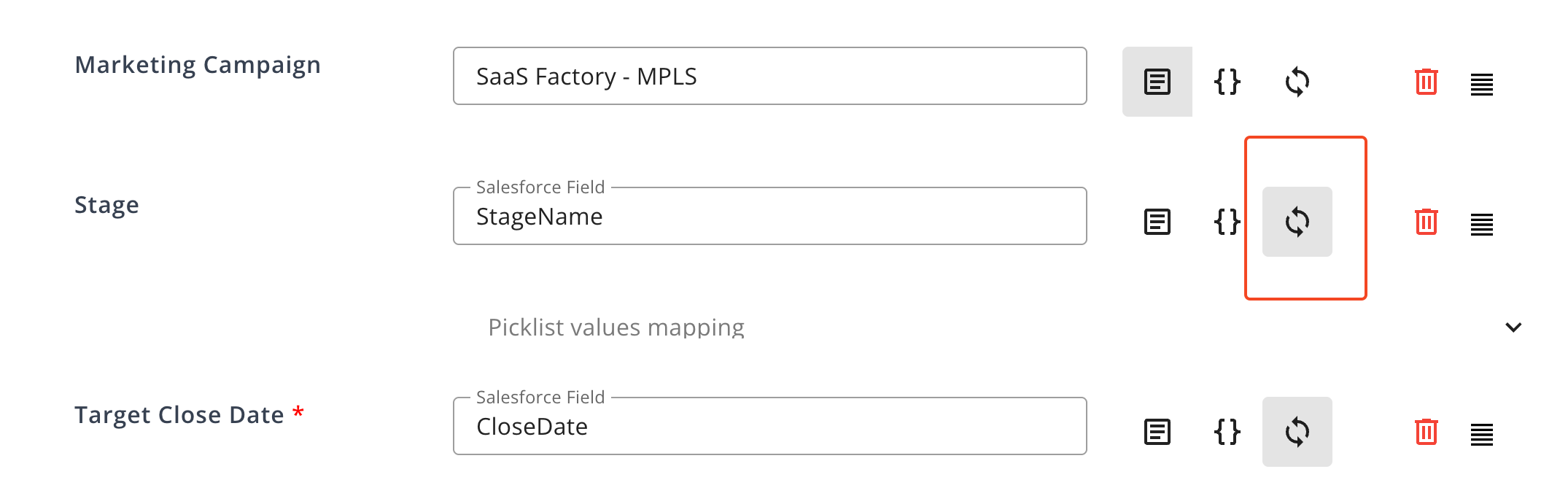 You can configure the following options:
* **Conditional sync with Expression Mode:** Click **Formula** on the row to set a conditional sync rule. See [Formulas (Expression Mode)](#formulas-expression-mode).
* **Picklist values mapping:** Click **Picklist** on the row to define custom value mappings between CRM and Cloud Partner fields. See [Picklist Value Mapping](#picklist-value-mapping).
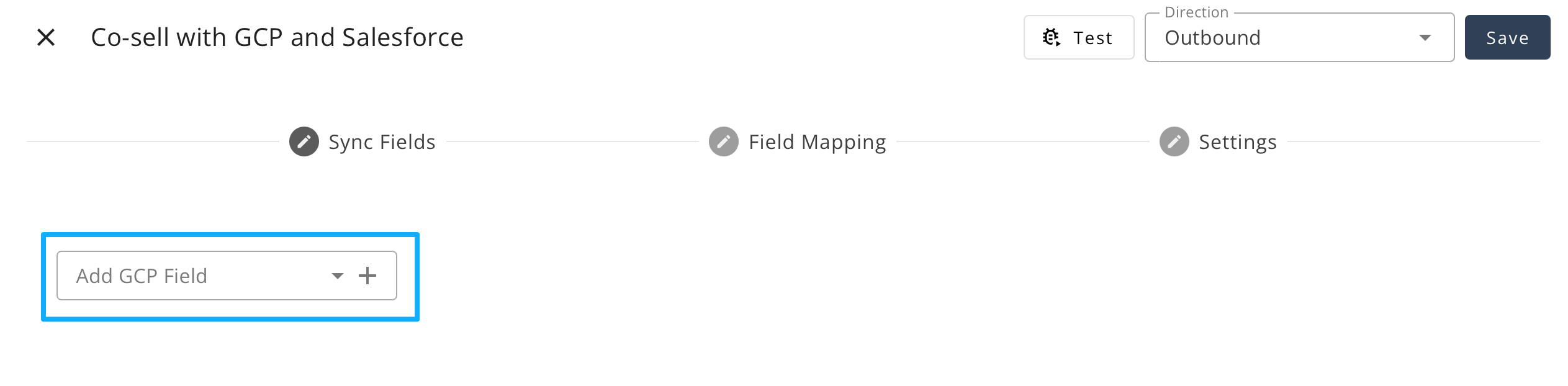
* **Add a Cloud Partner field:** Scroll to the bottom of the list and open the dropdown named for the partner (**Add AWS Field**, **Add Microsoft Field**, **Add GCP Field**). Search for the field and pick it to add it to the configuration list; see [New fields and unsaved changes](#new-fields-and-unsaved-changes).
>
 ## Inbound Setting
Inbound covers data **from the cloud partner to your CRM**. When a partner sends a referral, Fours writes it into the CRM objects on these tabs, using your mapping. Fours keeps applying the partner's later changes too. Inbound sync runs for AWS, Azure and GCP.
The **Setting** tab holds the inbound automations: Auto-Accept, Auto-Delete and Auto-Sync Contacts. See [Referral Automations](/cosell/setup/automations/).
### Objects Tab
Each object tab, such as Opportunity or Deals, Account or Companies, and Contacts, controls how a referral from the cloud partner is written into that CRM object.
In the configuration table, the title of each row represents the field name in the CRM. You can use the search dropdown to select which Cloud Partner's field should be mapped to it.
You can add or remove CRM fields to customize your own mapping rules.
Each row has the same value-source buttons as an outbound row — **Default**, **Formula** and
**Picklist** — and leaving them off maps the CRM field directly from the partner's field you pick.
**Picklist** is offered on Salesforce picklist and HubSpot dropdown (enumeration) fields, and
**Formula** opens the same Build / Code editor as on outbound rows, built from the partner's
fields rather than your CRM's. Use them to define complex data-mapping rules, including
conditional logic, value conversions, and cross-field mappings.
See [Picklist Value Mapping](#picklist-value-mapping) and [Formulas (Expression Mode)](#formulas-expression-mode) for
detailed documentation and examples.
#### Mapped values your CRM does not accept
A CRM dropdown field accepts only its own options. While you edit an inbound mapping into Salesforce
or HubSpot, for AWS, Azure, or GCP, Fours checks what each field would receive against your CRM's
own field definitions and lists the values it will refuse in a **These values may not reach your CRM** panel.
Each line names the field, the value, and the options the field accepts. It flags:
- a source field mapped straight to a dropdown with no picklist mapping, so the partner's values are
sent as-is;
- a picklist mapping, a **Default Value**, or an **Expression Mode** expression with no template
fields, that sends a value the field doesn't have.
The panel is advisory, and you can still save. The usual fix is a
[Picklist Value Mapping](#picklist-value-mapping) that translates the partner's values into the
field's own.
When an inbound sync then writes a referral into your CRM, a value the field can't accept is
**left out of that write** rather than sent. The other mapped fields still land, where before one
refused value could void a whole HubSpot write and leave every mapped field on the deal empty.
Nothing already on the record is cleared.
```d2
direction: right
value: "Mapped value\nfor a CRM field"
check: "Does the field\naccept it?" { shape: diamond }
write: "Written with the\nother mapped fields"
omit: "Left out of this write\nother fields still land\nnothing is cleared"
value -> check
check -> write: "yes"
check -> omit: "no"
```
| CRM | What Fours checks | What it doesn't |
| --- | --- | --- |
| **HubSpot** | Dropdown properties, against the options the property lists. A date property also receives a proper date rather than a raw timestamp. | Properties whose options HubSpot doesn't list, including **Deal Stage**, whose values belong to the pipeline. |
| **Salesforce** | Restricted picklists. An inactive picklist value counts as not accepted. | Unrestricted picklists and text fields, which accept any value. |
Values are matched exactly, with no case folding and no label matching, so translate them with a
picklist mapping rather than relying on a near match.
####
 Salesforce Only – Add Objects
>
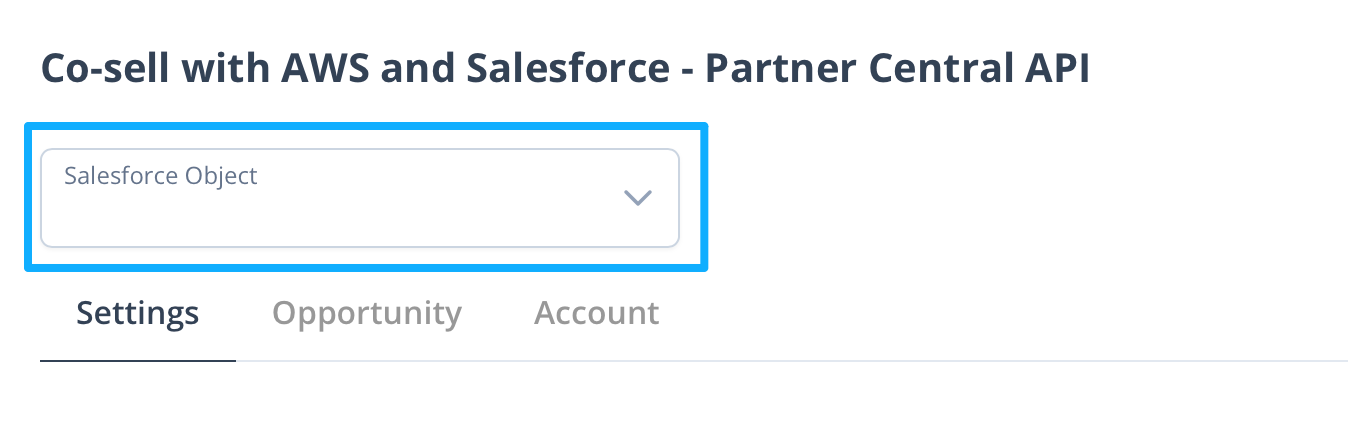 When syncing with Salesforce, you can use this field to search for and add more objects to sync, once the related field mappings have been completed. Mapping to custom Salesforce objects is supported, but typically requires a Solutions Engineering request to scope the trigger logic and data flow correctly. This isn't available for HubSpot.
## CRM-Specific Setup
### Salesforce
Before configuring, confirm the Fours Salesforce package is installed and the Integration User is connected in your Fours Console:
- **Integration User access**: Salesforce must be connected to Fours with the **Fours Integrator** permission set, and that user needs **Read** and **Edit** access to any Salesforce fields you intend to map.
- **Widget installation**: The Fours Quick Panel must be added to your **Opportunity** page layout.
When defining outbound field mappings, pay special attention to these Salesforce fields:
- **Owner attribution**: Map `Owner.Email` so the correct sales rep is credited in the AWS/Azure/GCP portal.
- **Customer website**: `Account.Website` is used as the primary key for account matching and [Auto-Enrich](/cosell/setup/automations/#auto-enrich-referrals).
- **Customer location**: AWS and Azure require valid country codes. Make sure `Billing.Country` is mapped correctly.
- **Close date**: `CloseDate` — partners reject dates in the past or more than two years in the future.
- **ACE IDs**: The `Partner CRM Unique ID` (Opportunity ID) is usually mapped by default and doesn't require manual configuration.
- **Project details**: `Description` maps to "Customer Problem" — the primary field partner managers read.
**Fields on related records.** In the Salesforce field picker, a lookup field — such as the
opportunity's account or its primary campaign source — has an arrow. Open it to list the fields of
the record it points to, and pick one of those to map a value such as `Account.Website` or
`Campaign.Name`; the picker shows each field's path under its name. A lookup opens when it points to
a custom or external object, or to one of these standard objects: Account, Campaign, Case, Contact,
Content Document, Content Version, Contract, Lead, Opportunity, Opportunity Contact Role,
Opportunity Product, Order, Price Book, Quote, Record Type, or User. A lookup to any other object,
such as Opportunity History or Product, lists no fields.
###
 HubSpot
Before configuring, confirm HubSpot is connected and verified under **Settings > Integrations**, and that the Fours App is added to your HubSpot Deal "Default View" (see [Set up the Fours App in HubSpot](/hubspot-app/hubspot-app-configuration/)).
To let Fours record which cloud partners each deal has been shared with, set up a **Referral State** property. The steps below are the short version; [HubSpot → Referral State](/integrations/hubspot/#referral-state) has the full setup.
**In HubSpot — create a property group (if needed):**
1. Go to **Settings**, then **Properties** under **Data Management**.
2. Select **Deal properties** from the object dropdown, then open the **Groups** tab.
3. Reuse an existing group, or click **New Group** and create one.

**In HubSpot — create the property:**
1. On the **Properties** tab, click **New Property**.
2. Confirm the object type is **Deal**, and choose your group.
3. Label the property "Referral State" (or any name you prefer).
4. Set the field type to **Multiple Checkboxes**.
5. Add at least three options whose internal values are exactly **AWS**, **Azure**, and **GCP**, including case — **Verify** checks for those three values.
6. Click **Create**.
**In the Fours Console — register the property:**
1. Go to [**Settings > Integrations**](https://console.suger.io/settings?tab=integrations) **> HubSpot card**, and click **Edit**.
2. In the **Advanced** section, find **Deal Referral State Property**.
3. Enter the property's **Label** (not its Internal Name). If it isn't listed, click the refresh icon to reload it.
4. Click **Verify**, then **Save**.

5. Back on the HubSpot integration, click **Sync** to populate the referral state on existing deals. This can take several minutes.
:::tip
Once the property is populated, the **HubSpot** section of the **Co-Sell** page lists only the deals whose Referral State is empty, the ones not yet shared with AWS, Azure, or GCP. Fours applies this only while the property is a **Multiple Checkboxes** field with the **AWS**, **Azure**, and **GCP** options; with any other property, the section lists every deal. The property itself is not offered in that section's filters.
:::
**Customer contact.** The default outbound mappings for AWS, Azure, and GCP fill the referral's
customer contact from the deal's contact properties (`contacts.firstname`, `contacts.lastname`,
`contacts.email`, …). A deal can carry several contacts, so Fours reads one. A deal with one
associated company, or none, uses its first contact. When the deal has two or more companies, Fours
reads the first contact on the deal that is associated with the deal's primary company; if none of
the deal's contacts is, Fours leaves the customer contact empty — associate the customer's contact
with the deal's primary company in HubSpot to fill it. See
[Which deal contact becomes the customer contact](/integrations/hubspot/#which-deal-contact-becomes-the-customer-contact).
## Test Field Mapping
Use the
 button to verify whether your field mapping configuration works as expected.
**Test Mapping is available on the Outbound field-mapping step only.** There is no
equivalent test on the Inbound tabs, though they do flag mapped values your CRM will refuse
while you edit — see [Mapped values your CRM does not accept](#mapped-values-your-crm-does-not-accept).
To check anything else about inbound behaviour, watch what an actual inbound referral writes into
your CRM.
**Test Mapping** opens the **Test mapping** dialog, which shows the referral the cloud partner
would receive for one of your CRM records — AWS, Microsoft, Google Cloud, or a Fours partner
(`SUGER`). Test Mapping is restricted to organization admins, because it runs live CRM queries
and your configuration's code; anyone else sees a message saying so.
1. Pick a record under **Test with**. The dialog opens on your most recent record, and the list
holds your latest ones; type to search it. With Salesforce, the search also queries Salesforce
by name, so you can reach older opportunities.
2. Fours reads the record from your CRM, applies your current mapping, and checks the result the
way the partner would. A mapping with **AI** fields can take several tens of seconds.
3. Read the result. **Preview** lays it out as the partner's own share form — for AWS, the
sections of the **Share to AWS** form in order — in one scrolling column, with the form's step
rail beside it following your place; a step is checked when its section has nothing to fix.
Fields your mapping fills that aren't on the share form come last, under
**Not on the Share to AWS form** (or the Microsoft or GCP form). Each value appears in a
read-only box, and a contact list shows one box per contact detail. **JSON** switches to the
raw source and target data.
A summary line at the top counts what needs fixing, for example *1 would be rejected · 2 would be
rejected unless auto-fixed · 1 failed to map · 1 required and empty*, followed by a **Go to first problem** link,
or reads *Nothing would be rejected or dropped.* Each section heading carries its own
**N to review** count. Under every field the preview names any problem, then where the value came
from — a CRM field (*from …*), a *Default value*, *Generated by AI*, or a *formula*, with *value
mapping* added when a picklist mapping applies. An empty value shows as —. When there is a specific
correction for a problem, the line also says what to change, worded for the row's value source —
for example, to switch the field to **Picklist** and map the CRM value to one the partner accepts.
| Problem line | Meaning |
| --- | --- |
| **Rejected** | The value is rejected as mapped, and the automatic fix Fours applies when you share will not repair it. Today this is AWS's **Estimated AWS Monthly Recurring Revenue**, whose line reads *AWS needs a monthly revenue above 0.* — see [Estimated AWS Monthly Revenue](/cosell/reference/ace-fields/#field-mapping-best-practices) |
| **Rejected unless auto-fixed** | The partner's validator rejects the value as mapped |
| **Dropped** | The partner's validator would silently remove or cut the value, so it doesn't arrive as mapped |
| **Not mapped** | The mapping for this field failed; the line gives the reason |
| **Required** | The partner requires the field, and it is empty |
| **Reformatted** | Informational: the value is rewritten into an equivalent form — nothing is lost |
| **Auto-fixed** | Informational: the partner's strict check refuses the mapped value, but the automatic fix Fours applies when you share repairs it, so the line names the value that is sent instead |
| **Not sent** | Informational: the value is removed because of another field on the referral, which the line names — your mapping is right |
| **Sent on update** | Informational: the partner's create request has no place for the field, so Fours sends it with the next update instead. Today this is Microsoft's **Sales Stage**, which must be one of Microsoft's stages and cannot move to an earlier stage except Lost |
The four informational lines are not counted as problems. Problems that belong to no single
field, such as a failure of the whole configuration, appear under **Other problems**.
The preview is stricter than a real share. When you share, Fours tries to fix rejected values
first — AWS and GCP referrals get an automatic AI fix, and Microsoft referrals have some invalid
values corrected — so a field marked **Rejected unless auto-fixed** may still go through. Fix the
mapping anyway rather than rely on the repair. A field marked **Rejected** will not go through: the
automatic fix never supplies a monthly revenue, because it can't see your CRM deal and any amount it
wrote would be a guess. A Fours partner (`SUGER`) configuration has no
partner validator, so its preview reports only mapping failures and empty required fields.
:::tip
The share page is your sandbox before finalizing any mapping — if data looks wrong or empty there, it'll be wrong in the partner portal. Open any opportunity and click **Share** to catch problems before they reach the partner. See [Outbound Referral](/cosell/referrals/outbound/).
:::
## Picklist Value Mapping
>
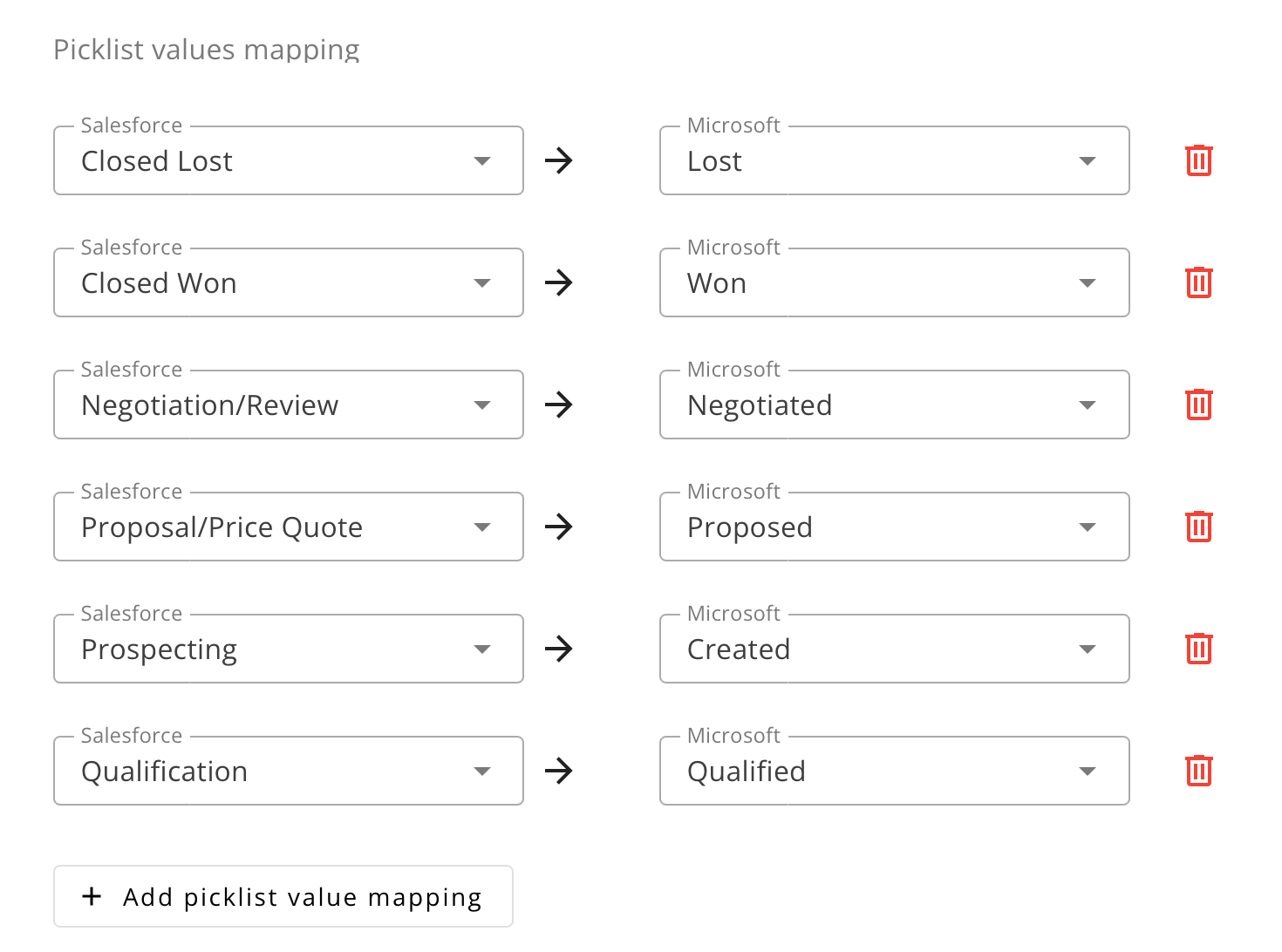 Some fields support Picklist Value Mapping, which allows you to define value correspondences between your CRM and Cloud Partner Platform.
This feature is used to create **simple one-to-one mappings** between different picklist values.
For example, the image above shows a Stage Name mapping where Salesforce stages are mapped to their corresponding Microsoft stages.
In other fields, you may need to enter values manually instead of selecting them from dropdown lists.
Users can add or remove mapping rows as needed to customize how each value aligns between the CRM and Cloud Partner.
**Where to find it.** Click **Picklist** on the row — on outbound and inbound rows alike. Pick the
source field under **Map values from**, then map each of its values. **Picklist** is offered only
when the target field has a fixed list of values. On a single-select field, a mapping row whose
target isn't on the field's list gets a line saying the partner doesn't accept that value, so a
referral sending it is rejected; pick a value from the list instead.
### Prevent a duplicate Closed Won
A stage-mapping row can carry an optional **Validation rule** that runs *before* the stage
transition is applied. Today one rule is offered: **Prevent duplicate Closed Won**.
It guards against a deal being counted as won twice — once in one cloud's co-sell portal, and
again in another — when the same CRM opportunity has already transacted elsewhere.
**Where to set it.** In the outbound configuration for **AWS**, open the stage picklist mapping
(**Picklist** on the stage row) and find the row whose **target** stage is `Launched` (AWS's closed-won equivalent). A
**Validation rule** dropdown appears next to that row, defaulting to **None**. Set it to
**Prevent duplicate Closed Won**. The dropdown is offered only on that row: it does not appear on
other stage rows, on inbound configurations, or on clouds that do not support the rule.
**What it does.** When a referral is about to move into the guarded stage, Fours looks for an
**accepted offer in a different cloud** — AWS, Azure, or GCP — attached to the *same* CRM record
as this referral. If it finds one, the stage update is **skipped**.
```d2
direction: down
update: "Referral update arrives\nstage moving to the guarded stage"
configured: "Validation rule set on\nthis stage-mapping row?" { shape: diamond }
linked: "Referral linked to a\nCRM opportunity / deal?" { shape: diamond }
lookup: "Look for an ACCEPTED offer\nin another cloud (AWS · Azure · GCP)\non the same CRM record"
found: "Conflict found?" { shape: diamond }
apply: "Stage update applied\nthen synced outbound to the partner"
skip: "Update SKIPPED SILENTLY\nnot saved · not synced outbound\nno error returned"
banner: "Cross Cloud Conflict banner\nshown on the referral"
update -> configured
configured -> apply: "no"
configured -> linked: "yes"
linked -> apply: "no — rule cannot run"
linked -> lookup: "yes"
lookup -> found
found -> apply: "no"
found -> skip: "yes"
skip -> banner
```
Three things are worth knowing about that skip:
- **It is silent.** Nothing is persisted, no outbound sync runs, and **no error is returned** —
the request looks like it succeeded. The referral simply stays in its previous stage.
- **It needs a CRM link.** A referral not linked to a Salesforce opportunity, HubSpot deal, or
Dynamics 365 opportunity has no record to match on, so the rule cannot run and the update
proceeds normally.
- **It is configuration-only.** There is no row action or picklist entry for it in the referral
list — you enable it here and observe it there.
Because the skip is silent, the referral detail page raises a **Cross Cloud Conflict** banner
naming the conflicting offer. That banner is how you find out. See
[Status & Stage](/cosell/referrals/status/#cross-cloud-conflict) for how to read and resolve it.
## Formulas (Expression Mode)
A formula sets a field's value with logic instead of a straight copy. Use one for conditional rules, value transforms, fallbacks, simple calculations and cross-field lookups. Formulas work on outbound and inbound rows.
Formulas are also called Expression Mode. They use [Go templates](https://pkg.go.dev/text/template) (`text/template`).
To translate a field's values one for one, use a [Picklist mapping](#picklist-value-mapping) instead.
### Open the formula editor
Click **Formula** on the row. The editor has two tabs:
- **Build:** put the formula together from a recipe, without writing a template.
- **Code:** write the Go template yourself. **Insert Salesforce field** (named for your CRM) adds a field reference for you.
On an inbound row, the formula reads the partner's fields instead of your CRM's.
### Build a formula from a recipe
On the **Build** tab, choose a **Recipe**:
| Recipe | What it does |
| --- | --- |
| **Transform a field** | **Take** a CRM field *as it is*, *multiplied by*, *divided by*, *plus* or *minus* a number, or *with text before* or *with text after* it. **Add field** adds another part. **Join with** sets what goes between parts: *a space*, *a comma*, *a dash* or *nothing*. |
| **IF / THEN rules** | **IF** a field *equals*, *does not equal*, *contains*, *is greater than*, *is less than* or *is not empty*, **Then send** a value. **Add rule** adds an **ELSE IF**. **Otherwise send** sets the value when no rule matches. |
Two limits stop a formula from sending something the partner can't use:
- **Single-select fields.** A new formula on a field that takes one value from the partner's list uses **IF / THEN rules** only. **Then send** and **Otherwise send** pick from that list.
- **Arithmetic needs a number.** On a Salesforce field, *multiplied by*, *divided by*, *plus* and *minus* appear only when the field holds a number (currency, percent or number). Pick another field type, and the step goes back to *as it is*.
Both recipes produce the same kind of Go template you would write on **Code**.
**Hand-written code pauses the builder.** If you wrote a formula on **Code**, **Build** says so and offers **Use the builder**. It first asks **Clear the hand-written code?** Choose **Keep the code** to leave it, or **Clear code and use builder** to replace it. Opening a configuration never rewrites a saved formula.
### Write a formula in code
Common uses:
- Conditional mapping (if / else)
- A default value when a field is empty
- String and number transforms, and simple calculations
- Reading one field to fill another
| Example | Template |
| --- | --- |
| Net revenue | `{{- multiply .Amount 0.8 -}}` |
| Unique title | `{{.Name}} {{.Account.Name}}` |
| Currency conversion | Multiply the CRM amount by a rate, the same way as net revenue. |
**Set a default country when empty.** This writes the company country if there is one. Otherwise it writes USA.
```
{{- if .companies.country -}}
{{ .companies.country }}
{{- else -}}
USA
{{- end -}}
```
### Formulas on Sync Fields
On the [Sync Fields](#sync-fields) step, a formula sets a conditional sync rule for the row.
### Check a formula
- Invalid template syntax makes the sync fail for that field.
- Use [Test Mapping](#test-field-mapping) to see the output before you save.
- Make sure each path you reference, such as `.companies.country`, exists in the payload.
- A hand-written template can only be edited on **Code**. Using the builder on that field replaces it.
- Each formula applies to one field. Other fields keep their own mapping.
| Error | Cause | Fix |
| --- | --- | --- |
| "unsupported partner: X" | Wrong capitalization of a partner name | Use all caps: `AWS`, `AZURE`, `GCP`. |
| Field highlighted in red on the share page | The value doesn't match the partner's data type, such as text in a date field | Use a formula to reformat it, or map a source field of the right type. |
## Troubleshooting
| Issue | Cause | Fix |
| --- | --- | --- |
| Can't create a second config for the same partner | Only one active configuration is allowed per cloud partner | Edit the existing config, or deactivate it first. |
| "This configuration was modified by another user…" when saving | Someone else saved the same configuration first | Reload, reapply your edit and save again. To avoid it, agree who owns a configuration before a joint editing session. |
| "This field is already synced by another filler" | Two field fillers claim sync on the same partner field | Turn sync off on one of them. |
| Field empty on the share page | The mapped CRM field is blank on that record | Fill it in the CRM and reload, or add a **Default** value. |
| Sync failed after a stage change | A CRM stage has no picklist mapping | Map every active CRM stage on the Stage row. |
| Referral status not updating in HubSpot | The Referral State property Label in Fours doesn't match HubSpot | Re-enter the property's Label (not its Internal Name) under **Integrations › HubSpot › Advanced › Deal Referral State Property**. |
| One mapped field stays empty after an inbound sync | The partner's value isn't one the CRM field accepts | Check the **These values may not reach your CRM** panel, then add a [picklist mapping](#picklist-value-mapping). |
| "Couldn't load HubSpot fields" or "Couldn't load Salesforce fields" on an AWS configuration | Fours can't read your CRM's field list. The connection usually needs reauthorizing. | Reauthorize the CRM under **Settings › Integrations**, then reopen the configuration. Until then, the rest of the mapping still shows but the CRM field pickers are empty. **Save** stays disabled, so the incomplete form can't overwrite your mapping. |
| "Couldn't load this configuration" or "Couldn't load this field mapping", and **Save** is disabled | The saved mapping didn't load, so the form on screen isn't your real mapping | Reload the page. **Save** stays disabled so an empty form can't overwrite the mapping you saved. |
For formula errors, see [Formulas (Expression Mode)](#check-a-formula). For automation problems, see [Referral Automations](/cosell/setup/automations/#troubleshooting). For failed referrals, see [Status & Stage](/cosell/referrals/status/).
## FAQ
**What happens if I delete a configuration?**
It is deleted at once, with its mapping logic and access tokens. You can't recover it.
**How do I handle different field names in different CRMs?**
A configuration pairs one CRM with one cloud partner. Define the mapping for each pair.
**Can I map from custom Salesforce objects?**
Yes, but it usually needs a Solutions Engineering request to scope the trigger logic. It isn't available for HubSpot.
**Do Fours roles inherit from Salesforce or HubSpot?**
No. Fours roles are set in the console under **Settings › Users & Roles**.